When people see a high-quality Thangka up close for the first time, their first reaction isn’t “This is a painting,” but rather awe.
The dense and precise lines, the intense red, blue, and gold tones, the complex relationships between figures, the almost direct gazes, and the abundance of flames, skulls, lotuses, ritual implements, and mystical symbols give Thangkas a visual power that is difficult for ordinary decorative paintings to replicate.
Stellora Wall Art focuses on the customization and production of high-end religious art, hand-painted works, and Thangka-style wall art. We can develop different levels of Thangka wall hangings and Tibetan art decoration solutions based on different clients’ spaces, sizes, themes, framing methods, and budgets.
However, many clients who are new to Thangkas ask several questions:
Why can a truly high-end hand-painted Thangka sell for thousands or even tens of thousands of dollars? Why do some Thangkas from hundreds of years ago still look so vibrant today? And why do some people feel a sense of oppression, or even a chill down their spine, when they first see certain Thangkas?
Today, Stellora Wall Art will unveil the secrets behind Thangka paintings.
I. Why are high-end Thangka paintings so expensive?
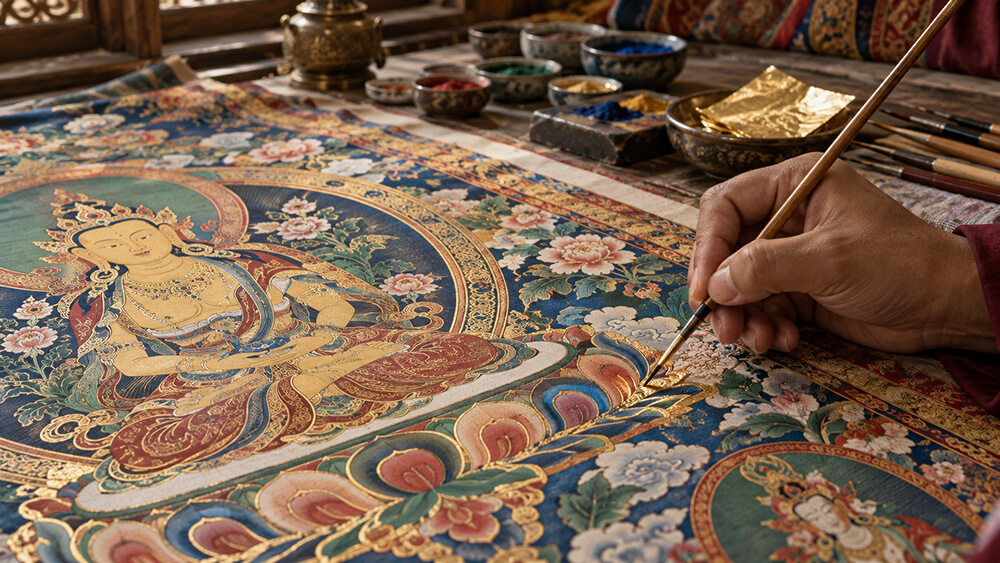
A truly traditional Thangka is first and foremost a work of art highly dependent on human craftsmanship.
Thangka painting is not simply a matter of free expression on a canvas. Traditional painting adheres to a complex set of iconographic standards regarding figure proportions, body structure, gestures, ritual implements, lotus pedestals, backgrounds, and overall composition. UNESCO, in its introduction to Regong art, also mentioned that Thangka techniques are typically passed down through apprenticeship and strictly follow the proportions, lines, color schemes, and pattern standards found in traditional Buddhist painting texts.
A skilled Thangka painter often requires extensive training.
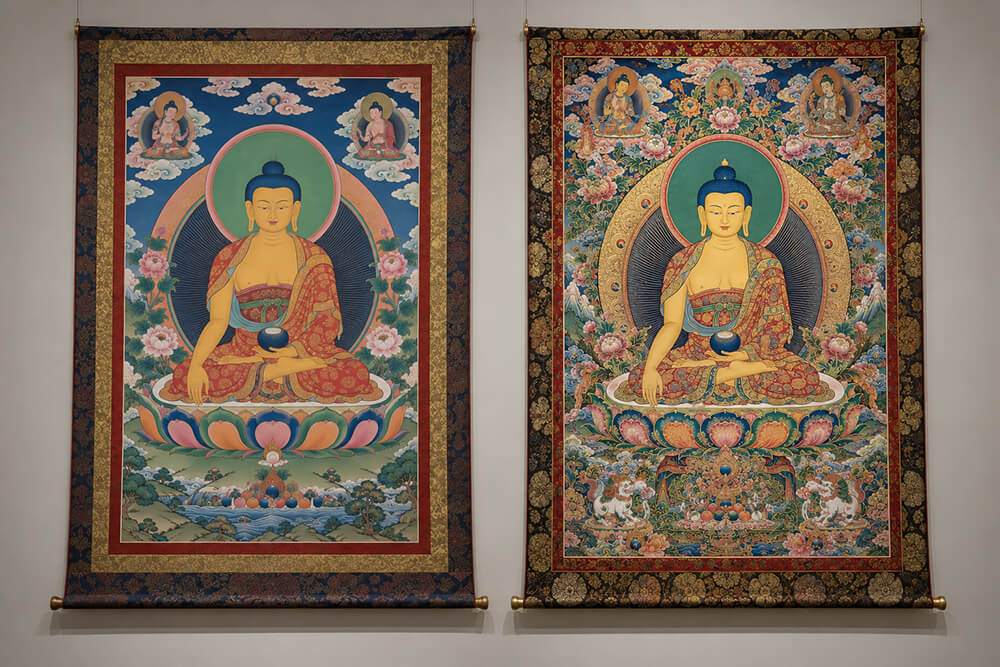
Some complex works, from preparing the canvas and sketching, repeatedly correcting proportions, to laying the base color, blending, outlining, painting the figure’s face, gilding, and final mounting, can take months or even longer to complete. Historical records indicate that large, complex Thangka paintings may require teamwork for months or even years, and mastering the traditional painting system itself can require years of study.
Therefore, the value of high-end Thangka paintings stems primarily from the time and human effort involved.
Secondly, there are the materials.
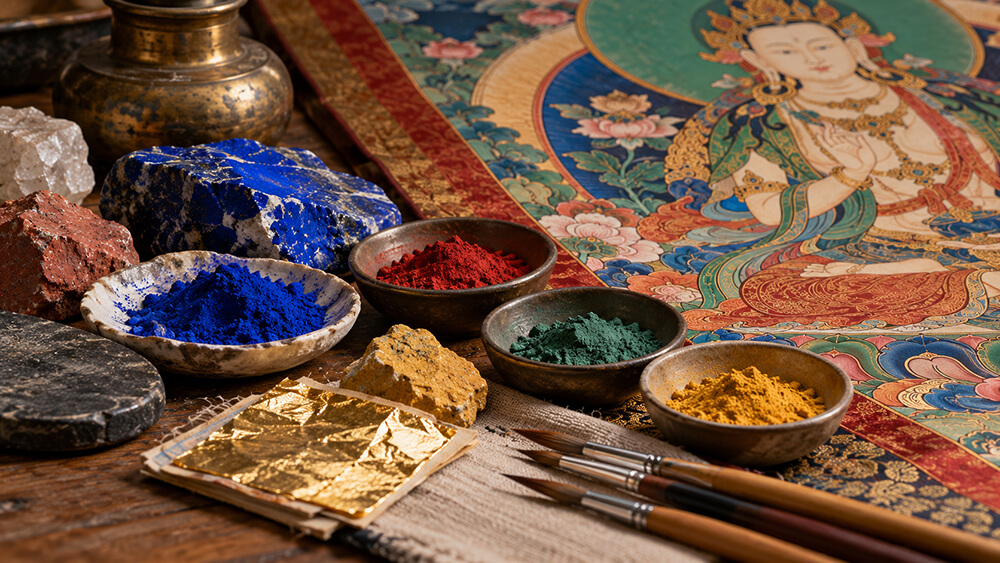
Traditional high-quality Thangkas don’t just use ordinary modern pigments. Historical works commonly use natural mineral and organic pigments, and some even extensively use gold powder or gold leaf. Several Tibetan Thangkas in the Smithsonian National Museum of Asian Art explicitly record the use of “mineral pigments and gold.”
As the size of the work increases, the number of figures increases, the details increase, and with the extensive use of gilding, mineral pigments, and high-grade brocade mounting, the production cost naturally rises rapidly.
Add to that the artist’s qualifications, school, age of the work, artistic level, condition of preservation, and provenance, and it’s not difficult to understand why high-quality Thangkas can fetch thousands of dollars or even more.
Therefore, purchasing a truly high-end hand-painted Thangka is not just buying “a canvas and some pigments,” but a collection of significant human time, traditional techniques, complex imagery, and cultural value.
II. Why do the colors of ancient Thangkas remain so vibrant after hundreds of years?
Many people hear the statement:
“The pigments used in Thangkas do not fade for thousands of years.”
This statement is very appealing, but from a scientific perspective, it needs to be more accurate.
Traditional Thangka paintings do indeed utilize a large amount of natural mineral pigments, such as those containing copper, iron, and mercury, as well as traditional colorants like cinnabar, azurite, and malachite, and may even use gold. When the British Museum scientifically analyzed a 17th-18th century Thangka, they discovered materials such as red lead, cinnabar, azurite, and gold.
Compared to some modern organic dyes, high-quality mineral pigments can indeed maintain their color for a very long time under suitable conditions.
This is why we can still see vibrant reds, blues, greens, and golds in some Tibetan and Himalayan artworks from hundreds of years ago.
However, this does not mean that Thangkas “never fade.”
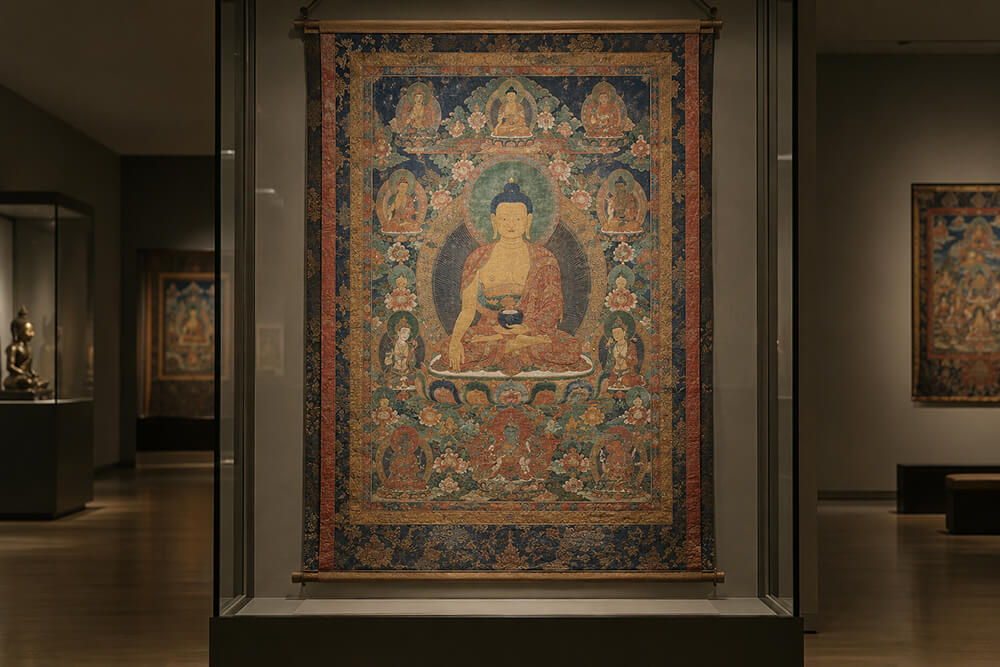
Light, temperature, humidity, dust, and the chemical changes of the pigments themselves all affect the artwork. The British Museum, during the restoration of Thangkas, discovered that some natural textile dyes had already shown significant fading, necessitating a low-light display method.
Even some ancient mineral pigments change over time. A Tibetan painting from approximately the 11th-12th century in the Metropolitan Museum of Art’s collection records the phenomenon of pigment crystallization over time.
Therefore, a more accurate statement would be: Excellent traditional mineral pigments, combined with proper painting techniques and a good preservation environment, allow Thangkas to retain remarkably vibrant colors even after hundreds of years.
This in itself is astonishing.
III. Why do some people feel a chill down their spine when they first see a Thangka?
This is one of the most interesting questions about Thangkas.
Especially when someone completely unfamiliar with Tibetan Buddhist art sees Mahakala, guardian deities, and some wrathful deities for the first time, they may indeed experience a noticeable sense of unease, awe, or even fear.
The reason can actually be explained through artistic language.
Many wrathful deities possess visual characteristics such as glaring eyes, fangs, skull crowns, flames, weapons, black or dark blue bodies, and a strong, direct gaze.
The Rubin Museum explains the wrathful deities in Himalayan art very clearly: these seemingly terrifying images do not simply represent “evil.” In relevant Buddhist traditions, some wrathful deities symbolize protection, wisdom, and compassion, and express the power to overcome obstacles and afflictions in a strong, even frightening, form.
In other words: They were designed to be visually awe-inspiring.
Flames, wide eyes, direct gazes, highly symmetrical compositions, and dense, complex symbolism create a powerful psychological impact on those unfamiliar with this artistic language.
Combined with monasteries, religious rituals, ancient legends, and preconceived notions of “mysterious Tibetan culture,” the first encounter with these images easily evokes a sense of awe or being “watched.”
This experience is a genuine psychological feeling, but it doesn’t necessarily imply the existence of any supernatural phenomenon.
After understanding the religious symbolism behind Thangkas, many people discover that the most ferocious-looking figures often express not intimidation, but rather power, protection, wisdom, and the overcoming of inner fears and obstacles.
Stellora Wall Art: Rediscovering Thangka Art
For Stellora Wall Art, Thangkas are not merely exotic wall decorations.
They are a unique art form that blends painting, religion, philosophy, craftsmanship, and traditional culture.
We offer customized Thangka wall hangings at various levels, including hand-painting, custom sizes, and custom framing, as well as wall art solutions for hotels, clubs, meditation spaces, spas, residences, and commercial spaces.
From high-end pieces with collectible and handcrafted artistic value to large-scale decorative Thangkas suitable for hotels, homes, and commercial spaces, we can develop designs tailored to different budgets, sizes, materials, and usage scenarios.
A truly worthwhile Thangka is far more than just a painting on the wall.
When you begin to understand its pigments, lines, proportions, figures, symbols, and history, you will discover that behind those images that initially evoke mystery and even awe lies a vast art world that has been passed down for hundreds of years or even longer.
Stellora Wall Art – Exploring traditional art, bringing ancient wall art into modern spaces in a new way.