It’s late. The desk lamp is the only light still on, and the whole room seems to lean toward that one wall. A full moon hangs behind two figures caught mid-stare, ink bleeding into cloud and crimson branch, white butterflies drifting off the silk.
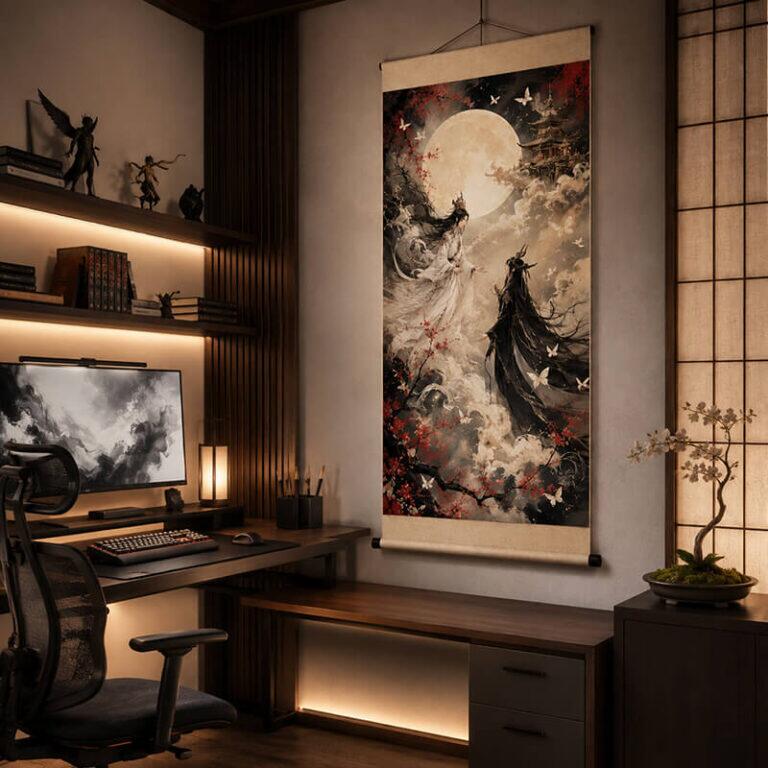
That’s the kind of quiet weight a wall scroll brings into a room — and it only actually works when the scroll hangs straight, stays safe, and sits at the height that lets it breathe.
كيفية تعليق لوحة جدارية دون إتلافها
A wall scroll is one of the most elegant ways to bring a calm, gallery feel into a room — but hang it wrong, and you’ll either end up with a crooked piece on the wall or, worse, a torn silk border and a cracked painting surface.
After hanging dozens of these for customers, I can tell you the whole job takes about ten minutes. The trick isn’t the drilling. It’s the measuring before you drill. Let me walk you through it.
First, Know How a Wall Scroll Actually Hangs
People assume the whole back of the scroll rests against the wall. It doesn’t.
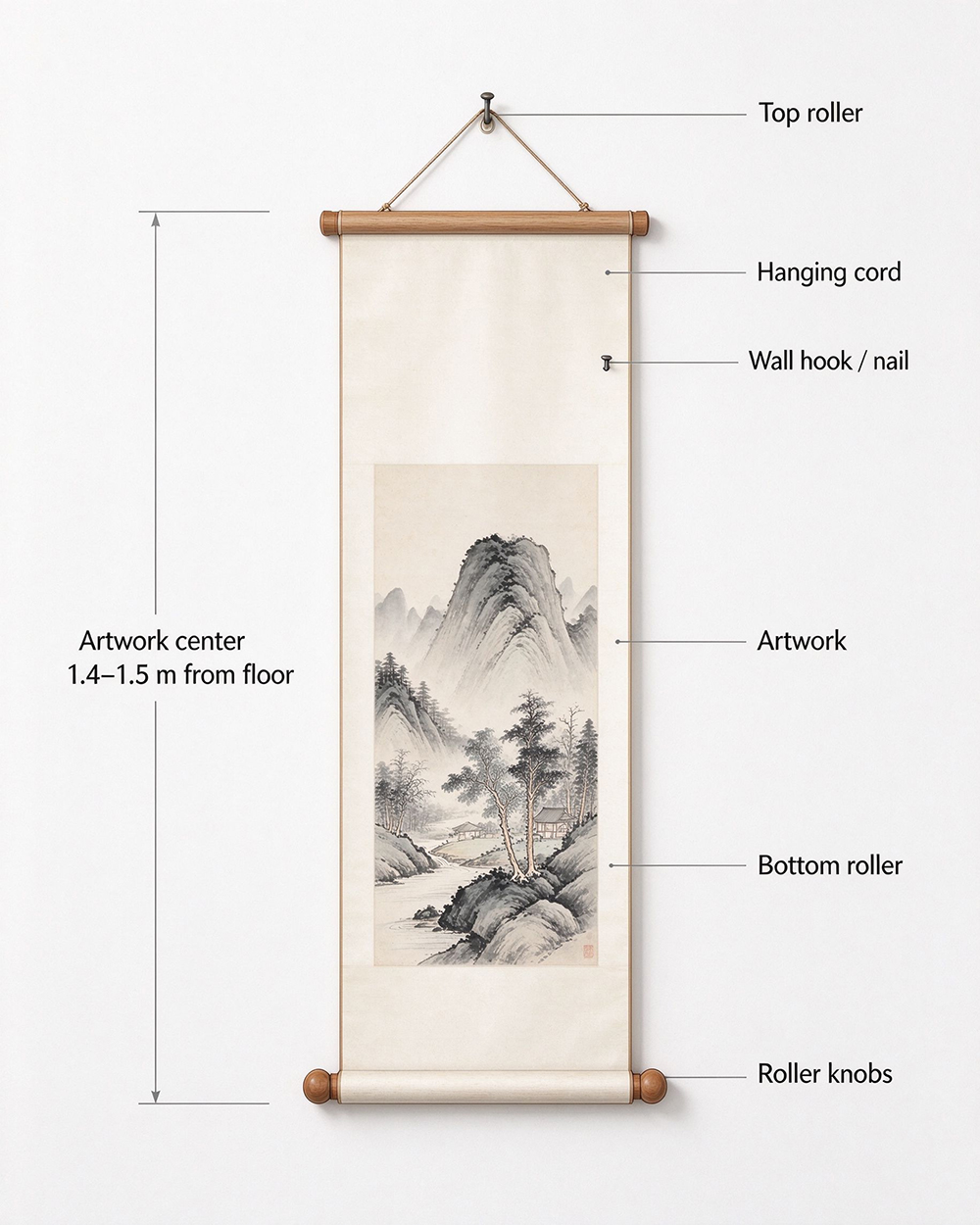
A traditional hanging scroll (called a zhou in Chinese) hangs from one point: a single cord tied across the top roller (the handan / tiangan). That cord loops over a hook, and the bottom roller (the diggan) simply hangs free with its two wooden knobs (zhou tou) at either end.
This matters, because it means:
- You only need one hook, not two.
- All the weight sits on that top cord and the hook, not on the painting.
- You should never tape, glue, or pin the bottom roller to the wall. Let it swing.
What You’ll Need
Grab these before you start:
- A hammer hook, picture hook, or adhesive wall hook (for light scrolls).
- A screw-in hook with wall plug if your scroll is large or heavy (over about 2 kg, or wider than 60 cm).
- A 3 m tape measure.
- A level — the one in your phone works fine.
- A pencil for marking.
- A small hammer (or a drill for concrete walls).
Step 1: Pick the Right Spot
Don’t walk in and start drilling. Spend two minutes on this.
The sweet spot is center of the painting about 145 cm (57 inches) off the floor — roughly eye level when you’re standing. That’s the height your eye naturally lands on, and it’s why museums hang things the way they do.
Then avoid:
- Direct afternoon sunlight. UV light fades ink and pigments fast.
- Above a radiator, heater, or AC vent. Heat and dry air crack the paper over time.
- Bathrooms or steamy kitchens. Moisture grows mold on silk and paper.
- Right behind a door — the handle will slam into it.
Step 2: Measure Before You Mark (This Is the Part Everyone Skips)
Lay the scroll flat on a table or the floor, fully unrolled. You need two numbers:
- A: How far the hanging cord rises above the top roller when you lift it by the cord. Usually 3–5 cm.
- B: Distance from the top of the roller down to the center of the painted artwork.
Now do the math:
Hook height from the floor = 145 cm + B + A
Example: if your artwork center sits 60 cm below the top roller (B = 60 cm) and the cord rises 4 cm (A = 4 cm), your hook goes at 145 + 60 + 4 = 209 cm off the floor.
Why this matters: if you just eyeball it, the painting ends up too high or too low, and you’ll be moving the hook three times.
Step 3: Mark and Put In the Hook
At that exact height, on your chosen center line, make a tiny pencil dot.
- For drywall or plaster: tap in a picture hook at a slight downward angle (about 30°) — it holds better than driving it straight in.
- For concrete or brick: drill a 6 mm hole, tap in a wall plug, and screw in a hook.
- Stay away from tile grout lines, drywall seams, and spots that sound hollow when you knock.
Step 4: Hang It and Level It
Loop the cord over the hook and let the scroll hang naturally.
Lay your level across the top roller (or the bottom one). If the left side sits lower, nudge the hook half a centimeter left; if the right side is lower, nudge it right. You’re usually only off by a hair.
That’s it. The bottom roller floats free — don’t touch it.
Hanging on Different Wall Types
- Painted drywall: A picture hook is perfect. It leaves a pinhead hole you can dab with toothpaste later.
- Wallpaper: Use a damage-free adhesive hook with a hook on it so you don’t rip the paper. Skip this for heavy scrolls.
- Tile or glass: Use a heavy-duty adhesive hook rated to at least 5 kg. Wait 48 hours after sticking it on before you hang anything.
- Plasterboard: Always use a cavity wall plug (butterfly anchor). A regular hook will pull straight through.
A Few Care Tips That Make It Last
- Every 4–6 weeks, roll it up and lay it flat for a day or two. Long vertical hanging stretches the silk border and can crack the painting over time.
- Roll it from the bottom up, evenly, so it doesn’t get a diagonal crease.
- Pick it up by both rollers, not by the cord alone — lifting by the cord alone can tear the silk where it’s sewn.
- During humid seasons, tuck a small silica packet near (not on) the frame.
Bottom Line
Hanging a wall scroll isn’t complicated — one hook, a quick measurement, and let it hang. Get the hook height right with that little formula, and your scroll will sit straight, stay safe, and actually look like the gallery piece it’s supposed to be.