In the previous two articles, Stellora Wall Art introduced common issues regarding wood carving decorative paintings, including wood selection, carving techniques, size and thickness, pattern customization, color treatment, weight control, and installation methods.
However, once customers enter the purchasing stage, they often have other more practical concerns, such as: Can wood carving paintings be placed in the bathroom? Can they be used outdoors? How should they be cleaned daily? Can bulk OEM or ODM customization be done? How long is the production cycle? Why is there such a significant price difference in wood carving decorative paintings on the market?
Below, we continue with detailed answers to questions 11-15.
1. Can wood carving decorative paintings be placed in the bathroom or outdoors?
Yes, but the appropriate wood and surface treatment must be selected based on the actual environment.
Wood is a natural material and is affected by changes in humidity, temperature, and sunlight. Therefore, ordinary indoor wood carving decorative paintings are not suitable for long-term direct exposure to high humidity, high temperature, or rain environments.
If the wood carving is intended for a typical residential bathroom, and the installation location is far from the shower area where there isn’t a significant amount of moisture in the environment, then wood carvings treated with moisture-proofing and surface sealing are generally suitable.
However, for hotel spas, near pools, sauna areas, or spaces with consistently high humidity, further enhanced moisture-proofing is necessary.
Common methods include using wood with better moisture resistance and applying a primer, sealant, waterproof coating, or wood wax oil for protection.
If the client wishes to use the wood carving outdoors, such as in courtyards, terraces, restaurant exteriors, or public areas of resort hotels, then the design requirements will be more stringent.
Outdoor wood carvings need to withstand sunlight, rain, diurnal temperature variations, and humidity changes simultaneously; therefore, more weather-resistant woods are typically used, along with professional outdoor waterproofing and UV-resistant coatings.
Even so, we still recommend installing the wood carving in a sheltered location rather than exposing it to strong sunlight and rain for extended periods.
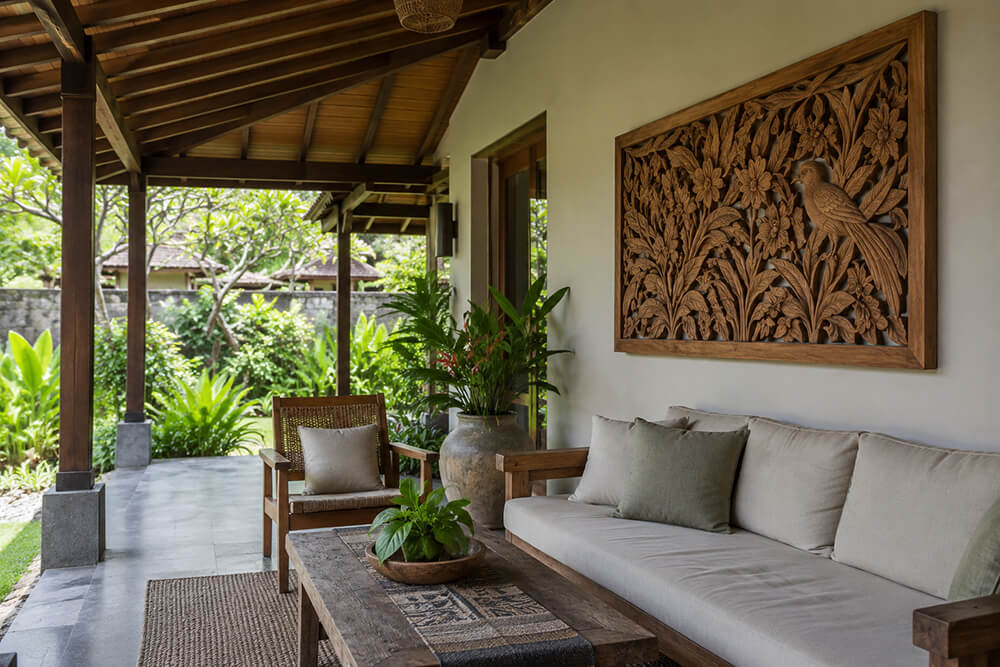
For projects intended for long-term outdoor use, sometimes metal, resin, or other composite materials are more suitable than natural wood.
Therefore, when Stellora Wall Art receives a project, they first understand the client’s specific usage environment before deciding whether to recommend wood, and what structure and surface treatment to use.
2. How should wood carvings be cleaned and maintained?
Daily maintenance of wood carvings is actually not complicated.
For most indoor wood carvings, the biggest daily problem is simply dust.
Flat or shallow relief carvings can be gently wiped with a soft, dry cloth; if the surface texture is complex, a soft-bristled brush or feather duster can be used to clean the carved grooves.
Openwork and deep relief carvings, due to their more pronounced textures, tend to accumulate dust in the crevices over time. A low-powered vacuum cleaner combined with a soft-bristled brush can be used for cleaning.
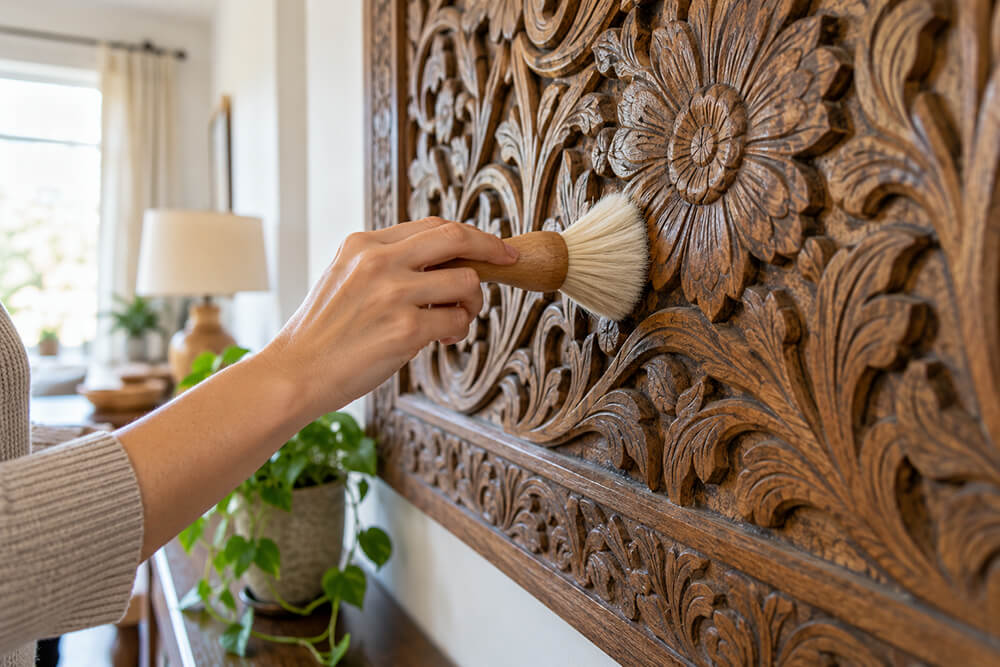
It is particularly important to note that it is not recommended to use large amounts of water directly for cleaning.
Natural wood absorbs moisture; long-term use of a damp cloth or direct spraying of water may affect the wood’s stability.
If stains must be removed, gently wipe with a slightly damp soft cloth, then promptly dry the surface with a dry cloth.
It is also not recommended to use strong acids, strong alkalis, alcohol, or highly corrosive cleaning agents.
For products treated with wood wax oil, if the surface gloss diminishes after many years of use, maintenance can be performed according to the specific coating.
If the artwork uses a sealed lacquer finish, daily dusting is generally sufficient.
Additionally, wood carvings should ideally be kept away from strong heat sources, such as fireplaces, high-temperature radiators, or continuously high-temperature equipment.
Maintaining relatively stable indoor temperature and humidity will help extend the lifespan of wood carvings.
3. Can wood carvings be customized in bulk using OEM and ODM?
Absolutely, and this is one of Stellora Wall Art’s key services.
For ordinary consumers, they may only want to customize one or two wood carvings suitable for their homes.
However, furniture retailers, home furnishing brands, e-commerce sellers, interior design companies, hotel buyers, importers, and decorative painting wholesalers typically need not just single products, but a complete product series for long-term sales or project installation.
The OEM model is primarily suitable for clients who already have their own product designs and brands.
Clients can provide patterns, sizes, logos, packaging requirements, and brand labels, and we will produce according to their standards.
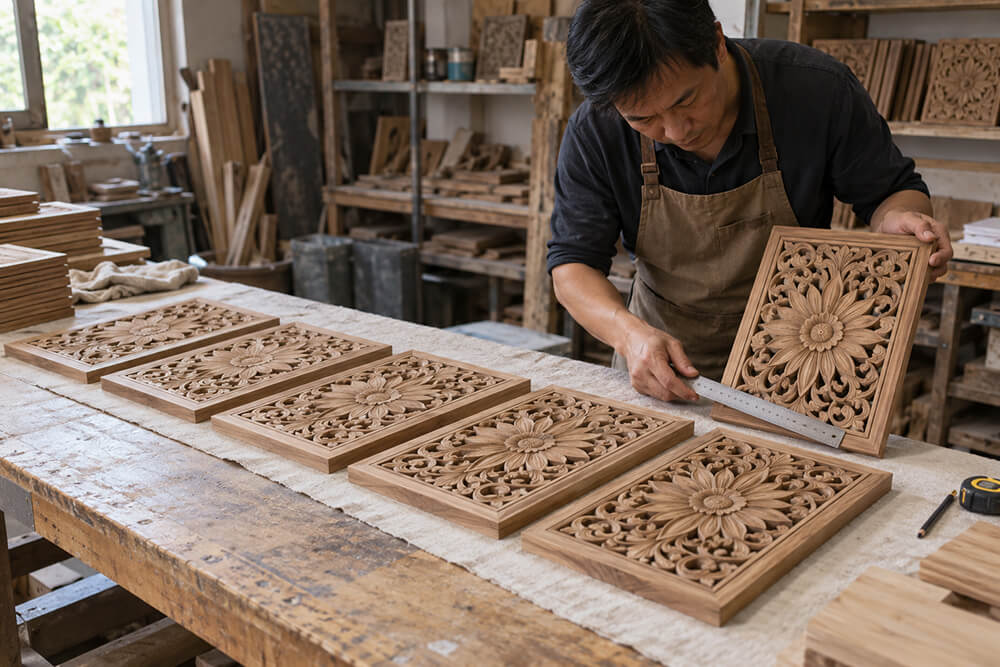
ODM is more suitable for clients who want to develop new products but do not have a complete design team.
For example, a client might tell us:
“I need to develop a set of modern wood carvings suitable for the US market.”
Or:
“I need a series of tropical plant wood carvings suitable for Southeast Asian resort hotels.” Stellora Wall Art can develop products based on market style, space usage, and production processes, and then create samples for client confirmation.
Customization can include wood, size, carving depth, color, pattern, installation structure, packaging, logo, instructions, and brand labels.
For long-term clients, multiple sizes and series can be developed around the same design language, creating a more complete market portfolio.
4. How long does it typically take to produce wood carvings?
The production cycle depends on the complexity of the product, the order quantity, and the surface treatment.
For standard wood carvings, if the design documents are finalized, the standard production cycle is approximately 10-25 days.
However, this is not a fixed time for all orders.
For simple CNC carvings, standard sizes, and regular colors, production is relatively fast.
However, if complex carvings, multi-layered joinery, extensive hand sanding, hand-painting, or antiquing techniques are involved, the production cycle will be longer.
Large orders also require consideration of wood preparation, moisture content control, and batch quality inspection.
For example, a hotel project requiring 200 identical wood carvings requires not only carving but also ensuring that all 200 pieces are as consistent as possible in size, color, structure, and installation location.
These types of projects typically involve creating samples before production begins.
Mass production only begins after the client confirms the samples.
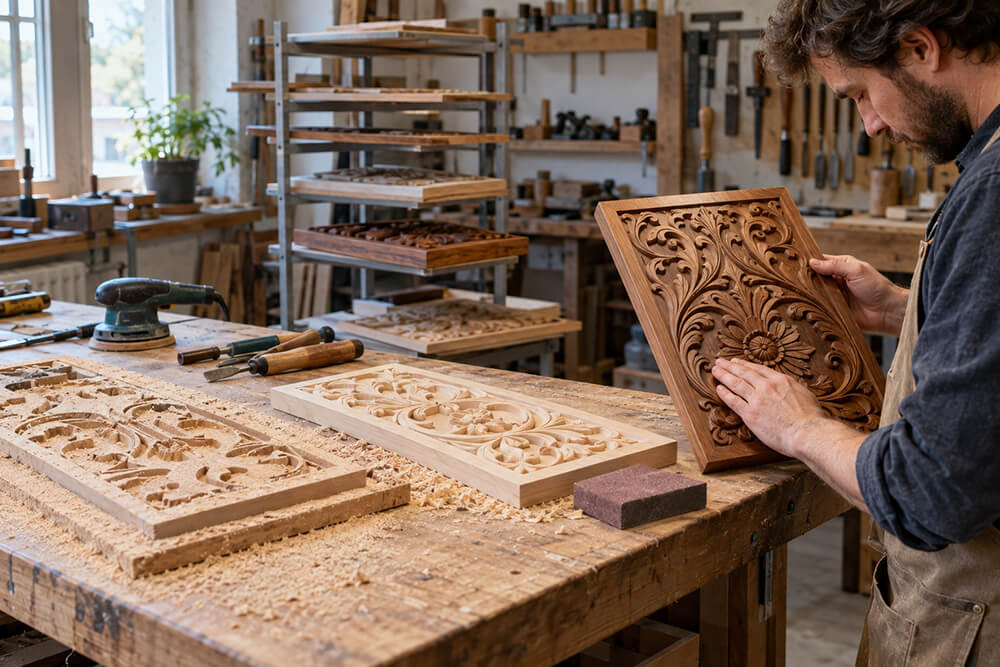
This reduces problems that may arise later due to differing interpretations of color, size, or craftsmanship.
For international orders, in addition to production time, packaging and shipping time must also be considered.
Stellora Wall Art usually provides a relatively complete delivery plan during the order confirmation stage, based on the product quantity, size, destination country, and shipping method.
5. Why is there such a large price difference in wood carvings?
This is one of the most frequently asked questions by clients.
A seemingly similar-sized wood carving on the market might cost only tens of dollars, while others could reach hundreds or even thousands of dollars.
This difference isn’t solely due to brand.
First, there’s the difference in materials.
There’s a significant cost difference between MDF, plywood, common pine, and premium oak or ash.
Second, there’s the thickness of the wood.
The material cost of a 1-centimeter-thick board is completely different from that of a 4-centimeter-thick piece of solid wood.
Third, there’s the complexity of the carving.
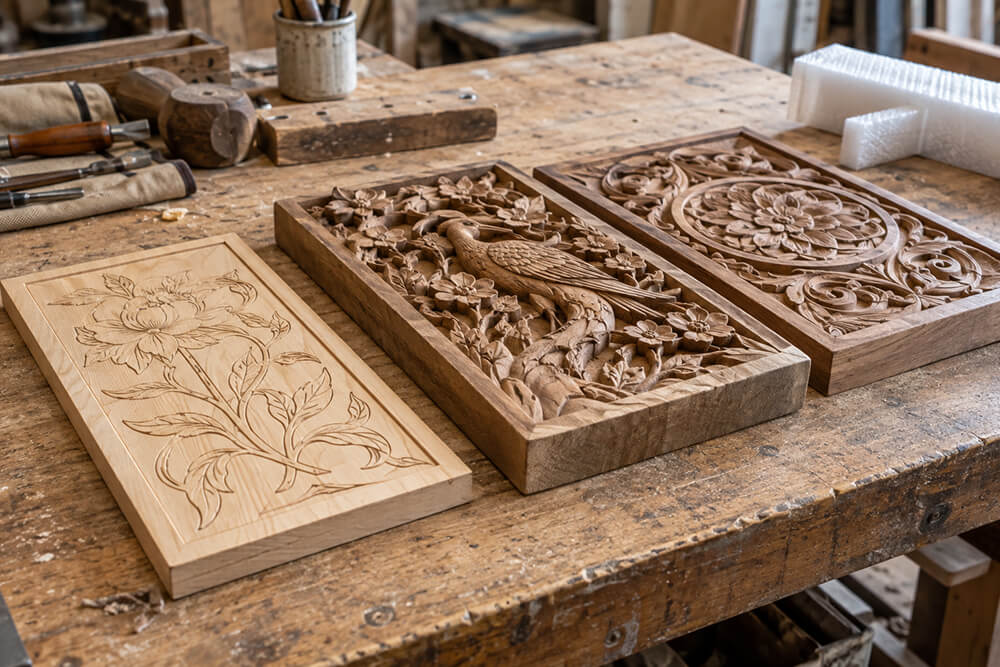
Simple line carving can be completed quickly, while high-density deep relief carving may require longer machine processing time, increasing tool wear and time for manual finishing.
Fourth, there’s the craftsmanship.
If the product only undergoes machine processing and simple coloring, the cost is relatively low.
If it requires manual sanding, hand-aging, staining, partial metallic effects, or multiple surface treatments, the labor costs will increase significantly.
Fifth, there’s the structure.
Large wood carvings may require additional back supports, frames, splicing structures, or hidden mounting systems to prevent deformation.
These structural elements, unseen from the front, directly impact product stability and cost.
Finally, there’s packaging.
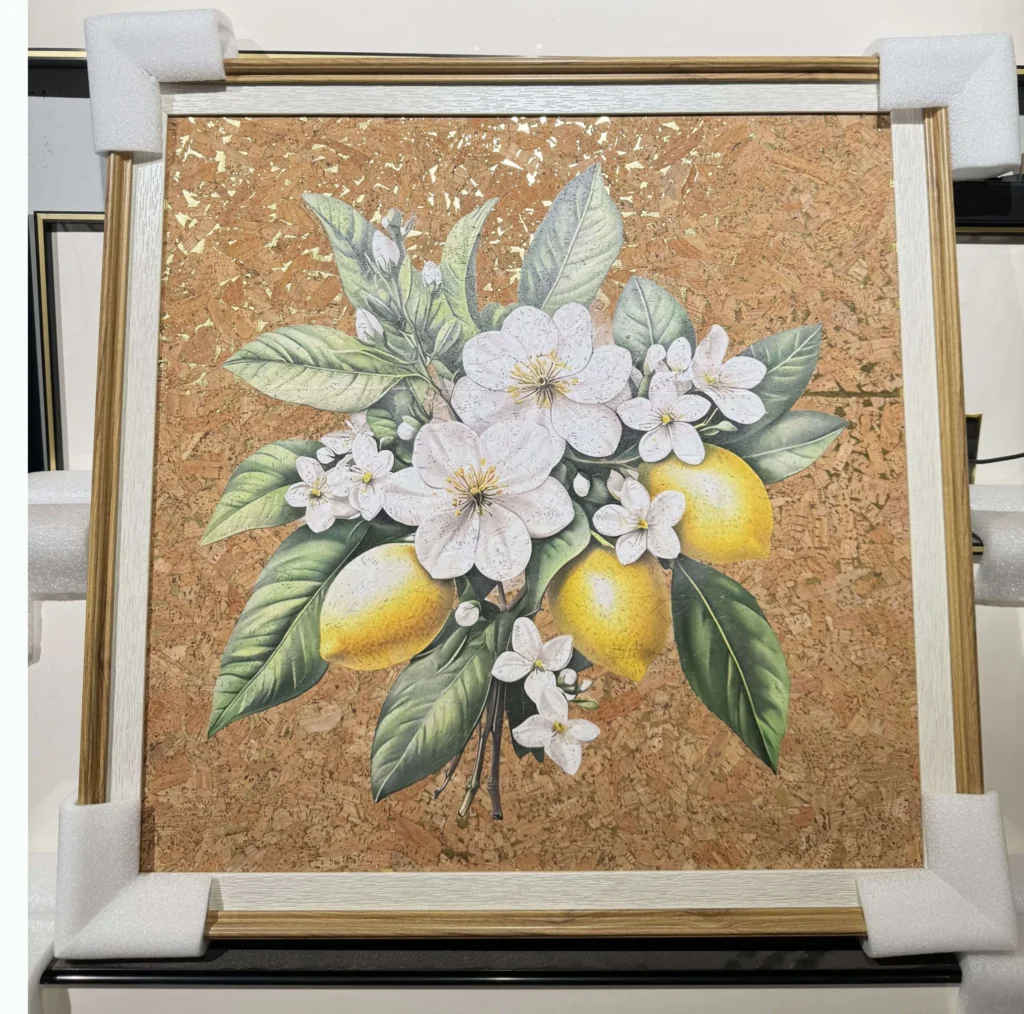
Large wood carvings truly suitable for international shipping require corner protectors, foam padding, reinforced cardboard boxes, and even wooden crates; otherwise, the risk of damage during transport is extremely high.
Therefore, when comparing quotes for wood carvings, one shouldn’t only ask “how much per square meter,” nor should one only compare product dimensions.
A truly reasonable price should consider: wood type, thickness, carving method, craftsmanship, surface treatment, structural design, packaging, and order quantity.
Stellora Wall Art: Behind every wood carving lies a complete production system.
A wood carving may appear as just an artwork on a wall, but from a production perspective, it involves multiple stages, including wood selection, drying, structural design, carving, hand sanding, coloring, installation accessories, packaging, and international shipping.
Especially for hotels, villas, furniture brands, and commercial projects, what truly matters is not just initial visual appeal, but also long-term stability, consistency in batch production, ease of installation, and safety during transport.
Decoración mural Stellora offers a one-stop service for wood carving decorative paintings, from design and development to sample making to mass production, catering to diverse client needs.
Whether it’s a single high-end custom piece, a small-batch brand test, or a large-volume order for hotels, real estate, and commercial projects, different materials and techniques can be selected based on actual budgets, space, and market positioning.
Truly excellent wood carving decorative paintings do not simply pursue expensive materials, but rather find the optimal balance between aesthetics, structure, cost, and long-term durability.