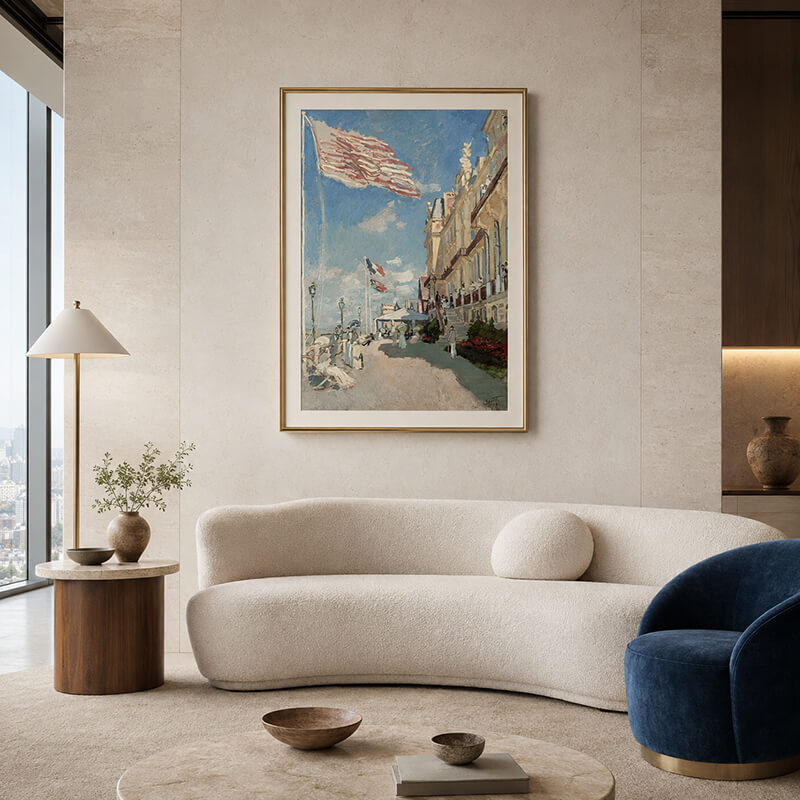
Monet’s Hôtel des Roches Noires, Trouville: Sunlight, Wind, and Impressionism
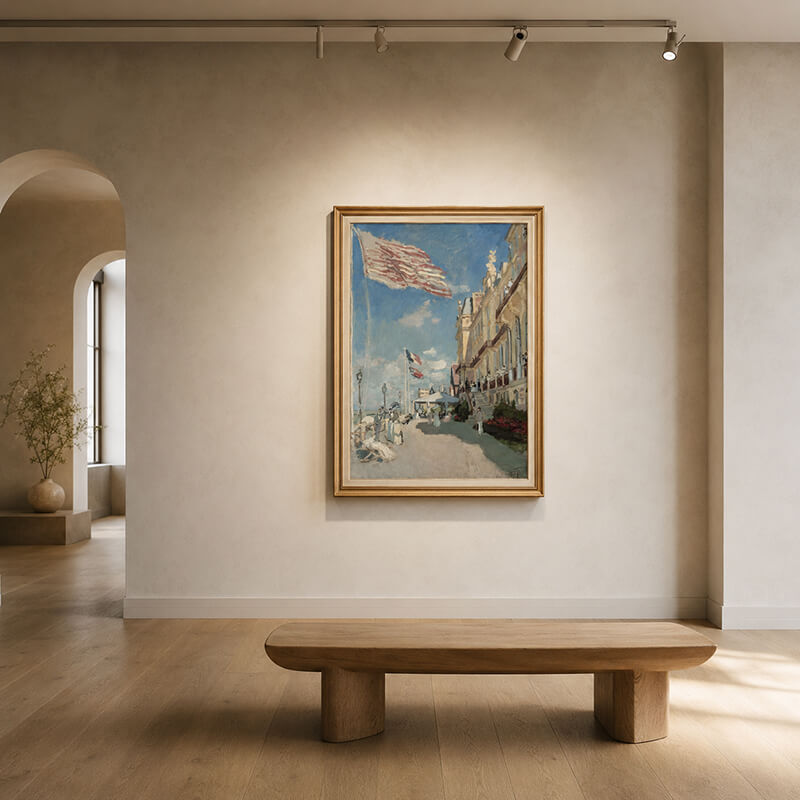
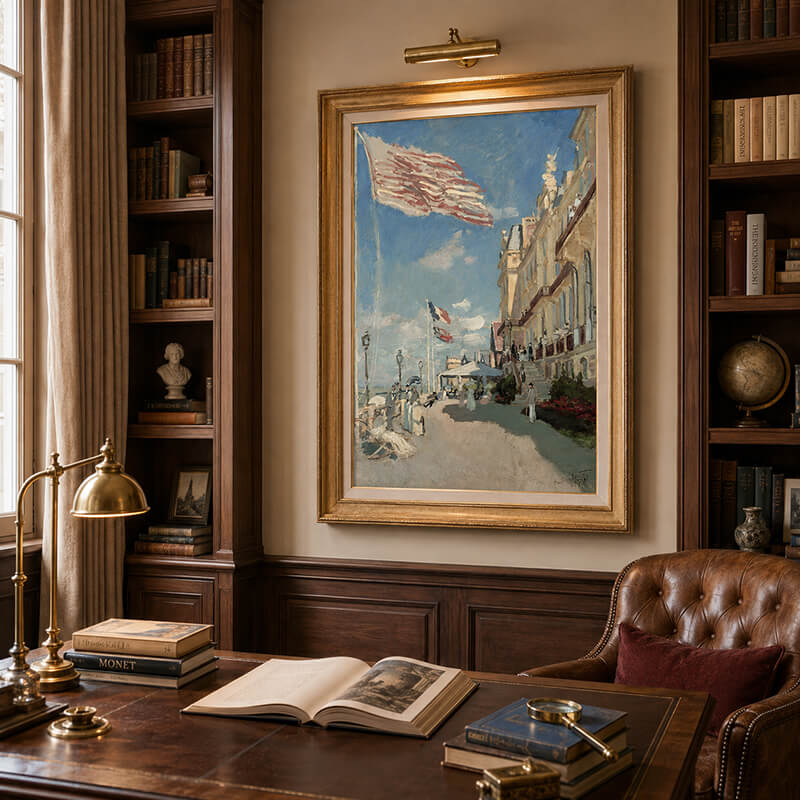
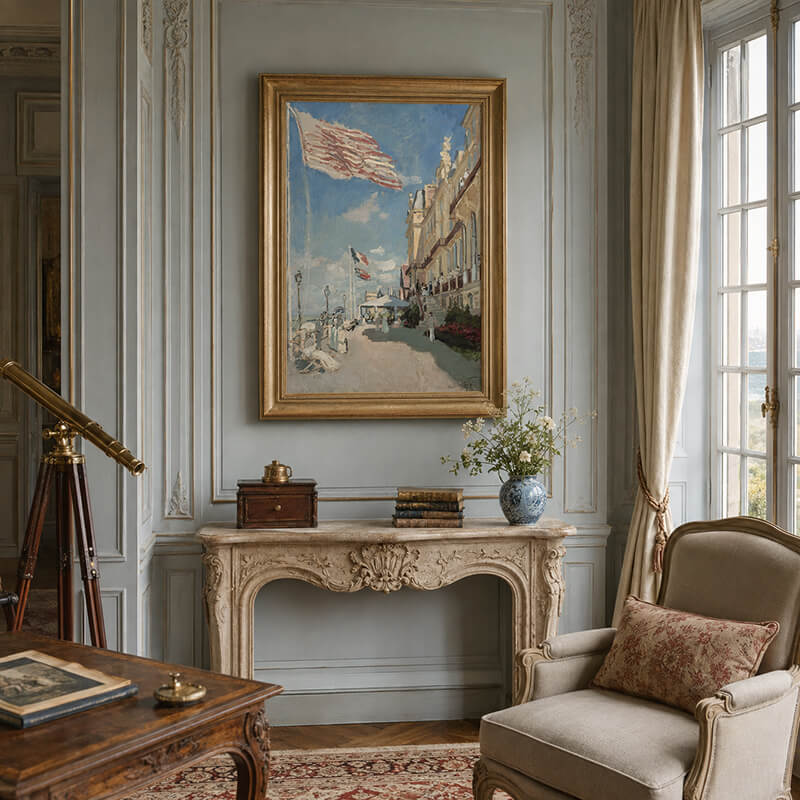
Painted in 1870, Monet’s Hôtel des Roches Noires, Trouville turns a fashionable Normandy hotel into a vivid study of weather and modern life. A striped flag sweeps across the blue sky, sunlight strikes the façades, and elegantly dressed visitors gather on the promenade. Rather than describing every detail, Claude Monet captures the sensation of a passing moment. The painting anticipates the methods that would soon define Impressionism.
Trouville Before the Franco-Prussian War
In summer 1870, Monet stayed in Trouville with Camille, whom he had married on June 28. The visit offered a brief interval of calm just before the Franco-Prussian War. Yet the setting was more than a private refuge. The Hôtel des Roches Noires represented the fashionable seaside culture of the Second Empire, where affluent visitors gathered for leisure and social display.
Monet followed a subject already explored by Eugène Boudin, an important early influence. However, he gave the resort greater visual immediacy. The Musée d’Orsay identifies the work as an oil on canvas measuring 81 by 58 centimetres and highlights its bold technique.
Light, Wind, and Plein-Air Observation
A Flag That Makes the Wind Visible
The large flag dominates the upper composition. Monet builds it with broad red-and-white strokes that seem to break apart in the moving air. Its diagonal force contrasts with the stable figures below. As a result, viewers do not merely see the wind; they almost feel it.
Sunlight and Tonal Contrast
Strong daylight illuminates the hotel’s cream façades, while cooler shadows cross the promenade. Monet places warm and cool tones beside one another, allowing contrast to produce brightness. Meanwhile, the tall format carries the eye from the shaded foreground toward the open sky.
Rapid Impressionist Brushwork
Figures, flowers, balconies, and clouds emerge through economical marks rather than precise outlines. Viewed closely, they remain separate touches of pigment. From a distance, however, they combine into an atmosphere filled with sunlight and motion. Thus, speed becomes a method of observation rather than a sign of incompleteness.
Impressionism and Modern Life
Monet presents contemporary leisure instead of mythology or heroic history. The hotel terrace, parasols, and public promenade reveal a culture of travel and recreation. However, he does not create a formal social portrait. Individual identities matter less than the shared rhythm of people, architecture, light, and weather.
Painted four years before the first Impressionist exhibition, the work advances a modern idea: ordinary experience can become serious artistic subject matter. Moreover, perception itself becomes the painting’s true theme.
Artistic Legacy and Display Value
Now held in the Musée d’Orsay collection, Hôtel des Roches Noires, Trouville connects Boudin’s coastal observation with the freer handling of mature Impressionism.
For collectors sourcing extra-large wall art for living room interiors, the painting also demonstrates the importance of proportion. Its vertical format suits tall walls, reading areas, and carefully framed focal points. A well-made reproduction should preserve the balance of blue sky, pale architecture, and animated red accents. Above all, it should retain the quality that makes Monet’s image enduring: a bright coastal afternoon still moving in the wind.