Monet Lavacourt under Snow 1881: Light, Color, and Winter Silence
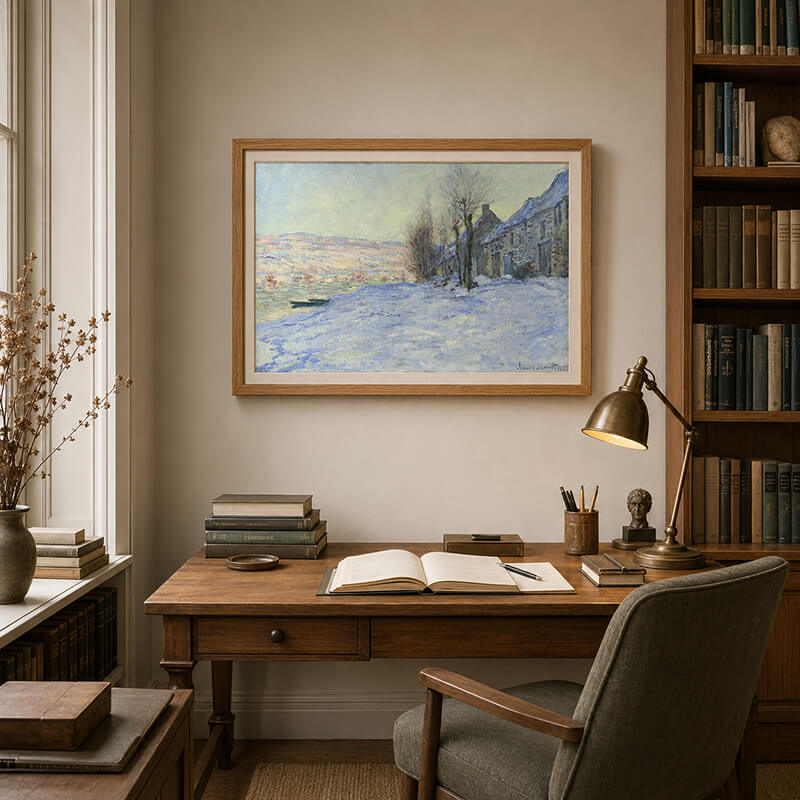
Monet Lavacourt under Snow 1881 invites viewers into a landscape transformed by frost, reflected light, and subtle color. Claude Monet does not treat winter as a blank white surface. Instead, he builds the snow from blue, violet, cream, and pale pink, revealing how light changes even the coldest scene. The result is quiet, atmospheric, and distinctly Impressionist.
Historical Context of Monet Lavacourt under Snow 1881
Monet beside the Seine
Lavacourt is a small hamlet on a bend of the Seine, opposite Vétheuil, where Monet lived from 1878. Here, he moved away from urban subjects and studied the rural landscape through changing seasons. The river, village buildings, and fields became a natural laboratory for observing weather and light.
The National Gallery, London, dates the picture to about 1878–81. Although Monet inscribed it 1881, the museum notes that he may have painted it during the severe winter of 1879–80, when the Seine froze.
A Period of Artistic Transition
Monet faced financial hardship after moving to Vétheuil. However, the quieter environment encouraged him to concentrate on landscape and paint outdoors more consistently. He also returned to similar views under different conditions, anticipating the serial method that later shaped his haystack and water-lily paintings.
Impressionist Snow Light and Color
Blue and Violet within the Snow
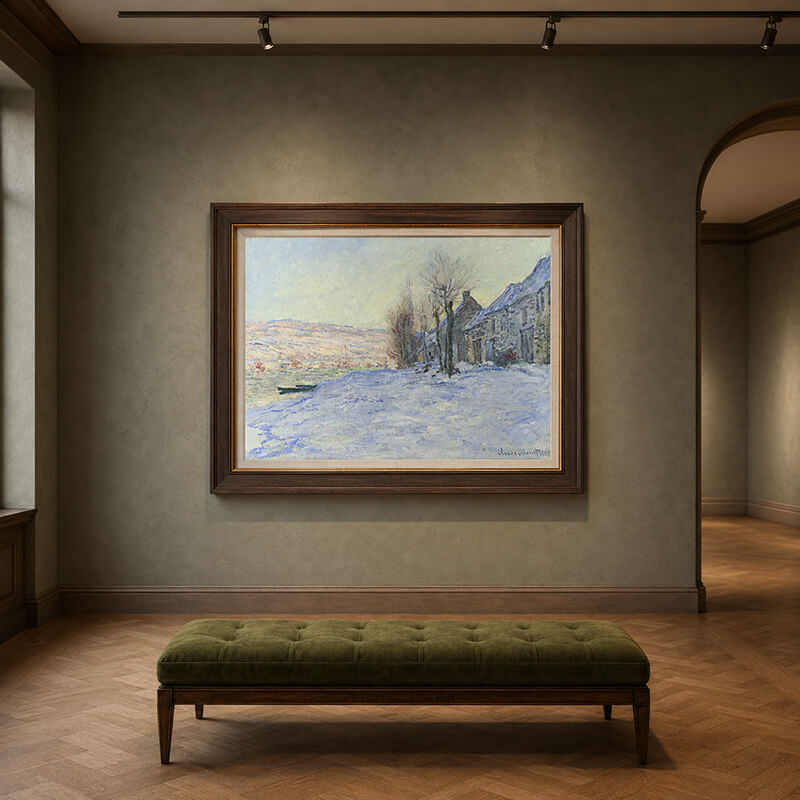
The foreground appears white at first glance, yet Monet overlays it with cool blue and lavender strokes. These colors suggest shadow, uneven ground, and the crisp atmosphere beside the river. Meanwhile, pale pink and cream tones brighten the distant bank, where weak sunlight warms the snow. Therefore, color temperature creates depth without detailed modelling.
Monet rejects the idea that snow has one fixed color. Instead, every area responds to light, distance, and surrounding forms. This sensitivity gives the landscape a living surface despite its stillness.
Brushwork and Composition
Broad, loose strokes describe the heavy snowbank in the foreground. In contrast, sharper vertical marks define the bare trees and dark cottages on the right. The horizontal composition leads the eye toward the river and distant hills, while the buildings provide visual stability.
Furthermore, the small dark boat interrupts the pale palette and anchors the left side. Monet balances open space with compact architecture, making the scene feel observed rather than staged.
Significance within Monet’s Winter Landscapes
Like The Magpie, Lavacourt under Snow shows Monet turning winter weather into a study of light. However, this painting feels less narrative and more immersive. Its restrained palette and broad snowfield focus attention on atmosphere, temperature, and perception.
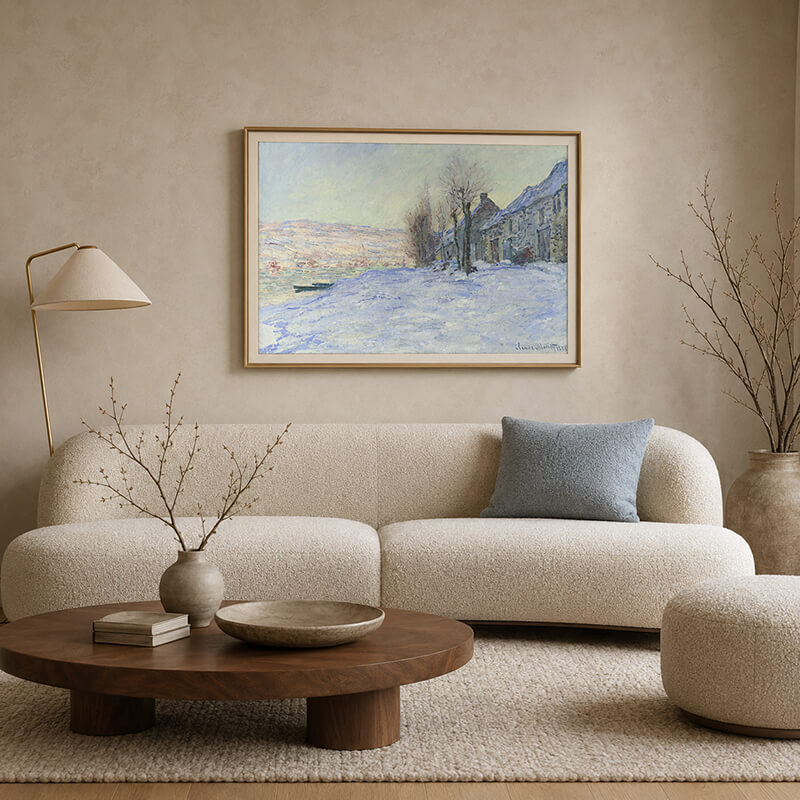
For collectors exploring extra-large wall art for living room interiors, the horizontal composition works especially well on wide walls. Its cool palette can complement warm wood, cream upholstery, muted gray, and soft blue accents without making a room feel harsh.
A Lasting Winter Impression
Monet Lavacourt under Snow 1881 transforms an ordinary riverside village into a meditation on winter light. By finding blue, purple, pink, and warmth within the snow, Monet teaches viewers to look beyond familiar assumptions. Which detail or color captures your attention most? Share your impression in the comments.