Among the many schools of Thangka art, Regong Thangka is a name frequently mentioned by collectors, art enthusiasts, and researchers of Tibetan Buddhist art.
A truly excellent Regong Thangka often gives the first impression of one word—exquisite.
The faces of the figures are only a small area, yet they are painted with extremely delicate eyebrows, eyes, lips, and expressions; the folds of clothing, lotus flowers, cloud patterns, ritual implements, and background architecture unfold layer by layer, and even under magnification, a wealth of details can still be seen.
Stellora Wall Art focuses on the customization and production of high-end religious art, hand-painted works, and Thangka-style wall art. We can develop different levels of Thangka wall hangings and Tibetan art decoration solutions based on different clients’ spaces, sizes, themes, framing methods, and budgets.
So, what exactly is Regong Thangka? Why is it so famous? Can a professional decorative painting manufacturer like Stellora Wall Art produce high-end Thangkas comparable to Regong Thangka?
Today, we’ll uncover the secrets.
What is Regong Thangka?
“Regong” is not a type of pigment, nor is it the name of a particular Buddha statue.
Regong art originated and flourished primarily in the Longwu River basin, around Tongren County in Huangnan Tibetan Autonomous Prefecture, Qinghai Province. “Regong art” encompasses various traditional art forms, including Thangka paintings, murals, appliqué embroidery, and sculpture, with Thangka being one of the most representative categories.
According to relevant data on Chinese intangible cultural heritage, Regong art originated in the 13th century and is an important school of Tibetan Buddhist art. It was included in the first batch of national intangible cultural heritage lists in 2006; in 2009, it was inscribed on UNESCO’s Representative List of the Intangible Cultural Heritage of Humanity.
UNESCO’s introduction to Regong art also emphasizes that traditional techniques have long been passed down through father-to-son and master-apprentice relationships. Painters must adhere to the traditional Buddhist painting system in aspects such as figure drawing, proportion, color matching, and pattern design.
This is key to understanding Regong Thangka: it is not simply a decorative painting copied from a photograph of a Buddha image by an ordinary painter, but rather a traditional painting system with strict rules regarding composition, proportion, color, and symbolism.
What are the characteristics of Regong Thangka?
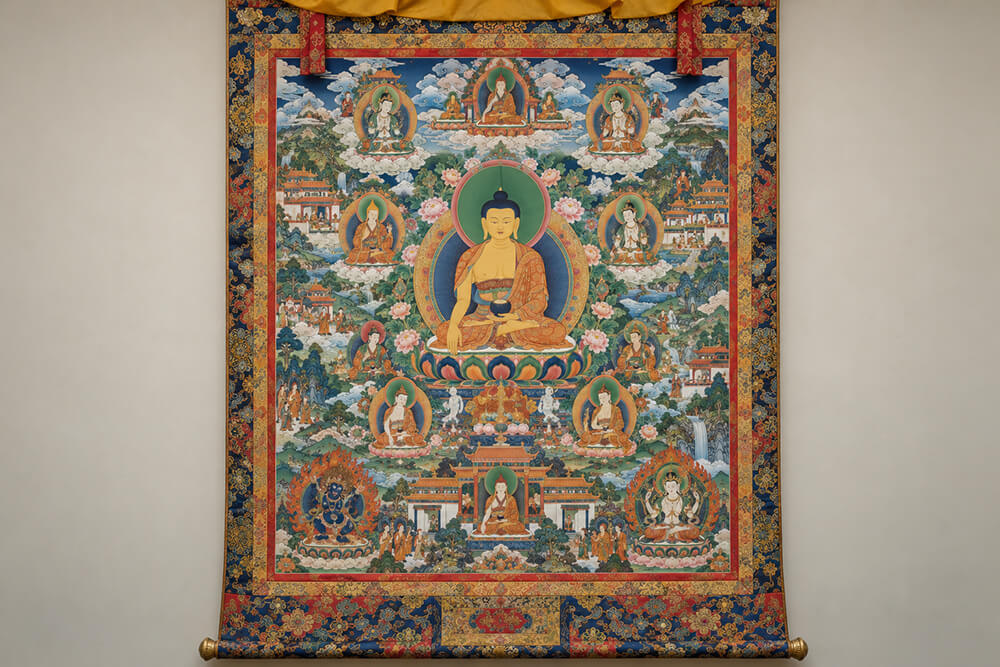
One of the most distinctive characteristics of Regong Thangka is its extremely full composition.
Many works leave almost no large blank areas. The main deity is usually located at the center of the painting, surrounded by bodhisattvas, protectors, disciples, auspicious clouds, lotus flowers, landscapes, palaces, and various religious motifs, forming a layered visual structure.
Descriptions of traditional Regong Thangka in Chinese intangible cultural heritage materials mention that its characteristics include a full composition, a wide field of vision, vibrant and unrestrained colors, extensive use of contrasting colors, and extensive use of gold for embellishment and outlining. Traditional Thangka paintings also exhibit different styles such as colored Thangka, black Thangka, and gold Thangka.
The second characteristic is the meticulous attention to line work.
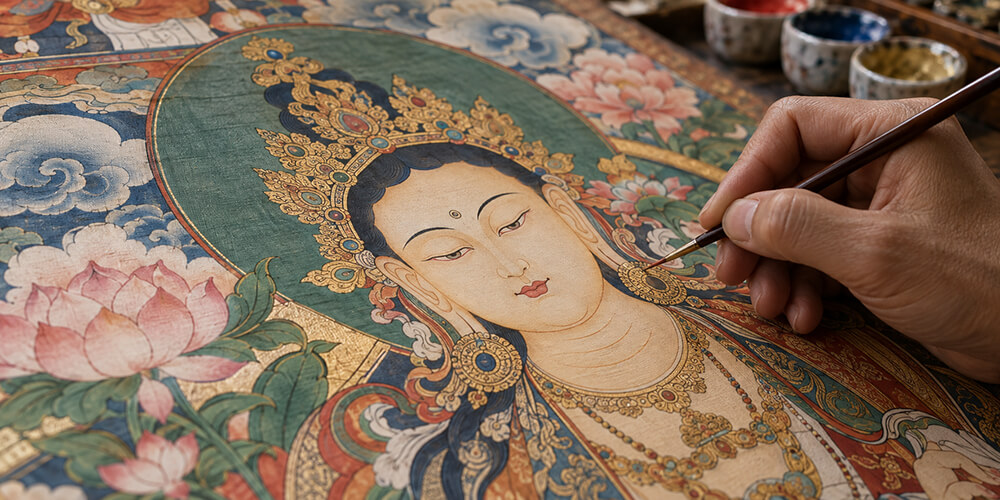
In truly good Thangkas, even if the figures are only a few centimeters in size, the eyes, eyebrows, nose, lips, and fingers still need to be clear and accurate.
The patterns on the clothing, the outlines of auspicious clouds, the petals of lotus flowers, and the halo and ritual implements also require very stable line-drawing skills.
Therefore, the more complex the Thangka, the higher the stability and experience required of the painter’s hand.
The third characteristic is the use of color and gold.
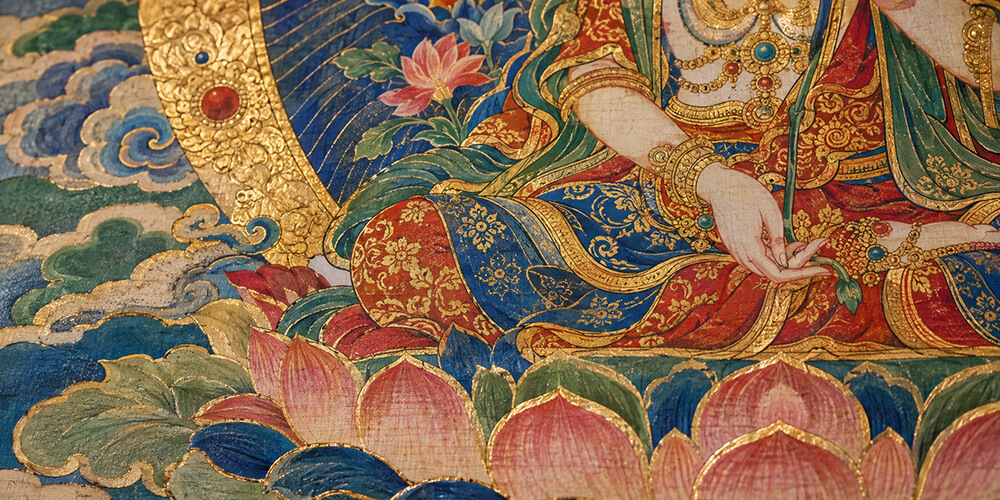
Many people seeing high-end Regong Thangkas for the first time will notice the strong reds, blues, greens, and golds, yet it doesn’t simply appear gaudy.
This is because traditional Thangka color schemes have a complete system; different colors are layered through variations in shade, gradations, outlining, and gilding.
Especially in the gilding of high-grade Thangkas.
Buddha crowns, jewelry, clothing folds, lotus pedestals, auspicious clouds, and even very small patterns may all be meticulously outlined in gold.
From a distance, you see a complete and solemn image; only upon closer inspection do you discover that what appears to be a simple area of gold may conceal dozens or even hundreds of intricate lines.
This is a key reason why high-end Thangkas require such a long production time.
Can Stellora Wall Art produce Thangkas comparable to Regong Thangkas?
This is the question many clients are most concerned about.
Our answer is: In the realm of high-end commercial customization and artistic decoration, Regong Thangka masterpieces can serve as a reference standard for craftsmanship and visual quality; however, “high-end hand-painted Thangka” and “authentic Regong Thangka with a clear intangible cultural heritage status” are two different concepts.
True Regong art is not merely a painting style; it also encompasses region, lineage, traditional techniques, and cultural heritage.
Therefore, if a work is not completed by an artist with a corresponding Regong art heritage background, we will not simply package it as an “Intangible Cultural Heritage Master Regong Thangka.”
This is Stellora Wall Art’s most basic respect for traditional art.
However, from the perspective of manufacturing high-end Thangka products, we can use Regong Thangka as an important quality reference.
For example, depending on the client’s budget and project requirements, we can choose high-thread-count canvas, traditional-style base materials, mineral pigments, high-quality gold materials, or even higher-grade real gold craftsmanship. Through processes such as hand-drawing, repeated outlining, layering colors, gradient shading, meticulous gilding, and hand-mounting, we can enhance the overall quality of the work.
For high-end orders, we pay particular attention to several details: the accuracy of the figures’ proportions, the fineness of the facial features, the stability of the lines, the depth and layering of the colors, the meticulousness of the gilding, and whether the entire work still withstands close scrutiny even under magnification.
Because a truly high-end Thangka shouldn’t just be “beautiful from afar.”
The closer you look, the more details you should discover.
This is precisely why exquisite Thangkas are truly irreplaceable by ordinary prints.
Stellora Wall Art not only produces Thangkas but also offers customized solutions at different levels.
Different clients purchase Thangkas for different purposes.
Some clients wish to use them for private collections; some for Buddhist halls, meditation spaces, or religious and cultural spaces; and others for hotels, clubs, spas, villas, and interior design projects, hoping to integrate Tibetan art elements into modern spaces.
Therefore, Stellora Wall Art offers different levels of Thangka customization solutions based on intended use.
From cost-effective decorative Thangkas to exquisitely hand-painted Thangkas, and even high-end collectible custom-made Thangkas using superior materials, extensive gilding, and complex figure compositions, we can tailor different production plans based on size, craftsmanship, complexity of the image, and budget.
We also support single-piece customization, small-batch customization, mass production, OEM, ODM, Private Label, and international DDP door-to-door shipping.
Respecting tradition is the key to truly creating excellent Thangkas.
Stellora Wall Art believes that the most important aspect of Thangka production is not simply telling clients,
“We can make anything.”
It’s about understanding what constitutes craftsmanship, tradition, and cultural heritage.
We can study why Regong Thangkas are beautiful, learn their lines, color schemes, composition, gilding, and traditional production methods, and continuously improve our hand-painting skills to give modern custom Thangkas increasingly higher artistic quality.
However, the true value of a Regong Thangka with a heritage comes not only from the image itself, but also from the artist, lineage, region, and cultural background.
We can strive for visual effects and production standards comparable to those of exquisite Regong Thangkas, but we will not easily replicate a cultural history that is not our own.
This is precisely Stellora Wall Art’s greatest understanding of high-end Thangkas.
Because true high-end art is never just about making a painting “look very similar.”
It’s about understanding why it’s painted this way, why the colors are chosen this way, why these lines are used, and why, after hundreds of years of tradition, people are still willing to spend months or even longer just to complete a single Thangka.
Stellora Wall Art—connecting traditional handcrafted art with modern manufacturing capabilities, providing global clients with high-end Thangka customization, hand-painting, OEM/ODM, and wall art project solutions.