

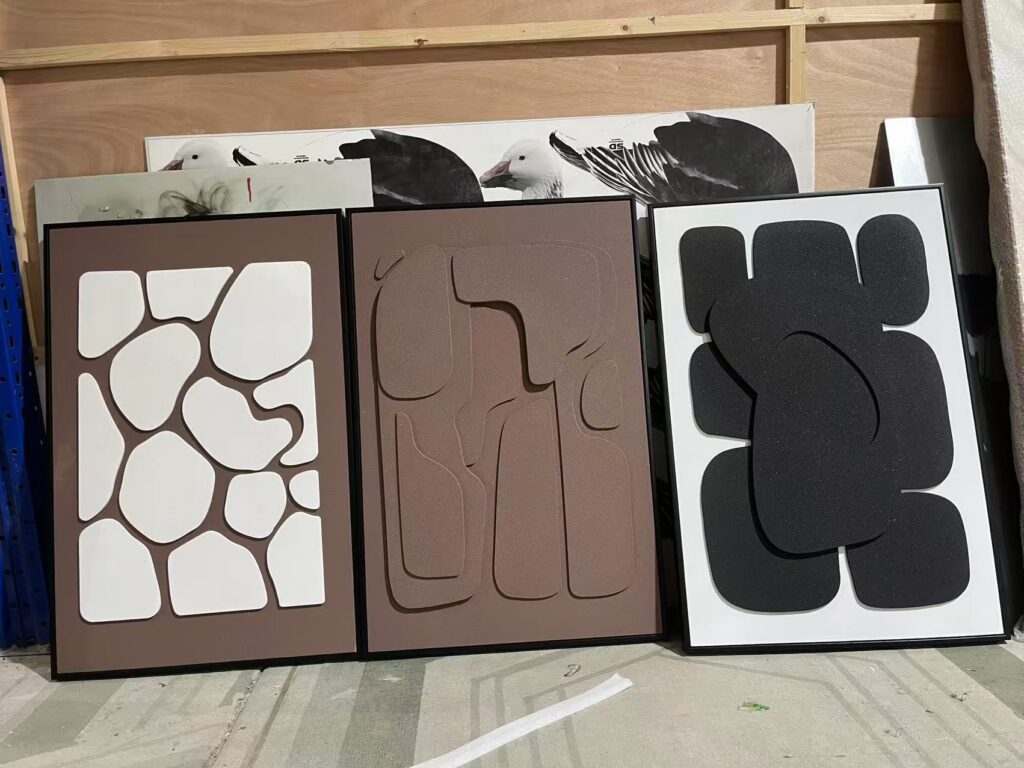

Abstract Textured Wall Art reveals different qualities as you move through a room. Brown, black and ivory establish the first impression, while layered shapes and granular surfaces reward a closer look.
Closer View of Abstract Textured Wall Art
Begin at the doorway, pause near your usual seat, then approach the frame. Each position reveals a different relationship between color, shape and surface. This simple viewing sequence can help you choose a composition that suits its setting.
Abstract Wall Art at First Glance
From across the room, broad shapes and tonal contrast take the lead. With brown and ivory textured wall art, pale pieces stand out against a darker ground. Black shapes on white create a stronger graphic emphasis.
First, assess the outline and the space around it. A composition should hold together at the distance from which you usually enter or view the room.
Layered Shapes at a Comfortable Distance
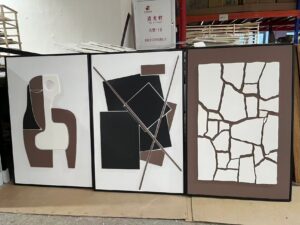
As you move closer, the arrangement becomes clearer. Rounded patches create irregular gaps, while overlapping forms introduce depth. Layered geometric wall art adds another rhythm through tilted blocks and crossing lines.
Next, notice how the edges guide your eye. Some designs gather attention around a central shape; others distribute it across several smaller elements. Consider which arrangement feels balanced from your sofa or chair.
Abstract Textured Wall Art Up Close
Near the frame, granular surfaces and raised edges become easier to examine. Small shadows help separate the layers, adding detail within a restrained palette.
Getty’s art viewing lesson encourages attention to surface texture, viewpoint and scale. Apply this approach by comparing a full view, an angled photograph and a close detail before choosing.
Choose a Place for Both Views
In an entryway, prioritize a clear silhouette that registers as you pass. Above a sofa, check the overall width from a seated position. In a hotel lounge, allow nearby seating to offer a closer view of the surface.
When comparing related pieces, browse Wallartura’s other material paintings and assess their overall forms alongside their surface details. This gives you a consistent way to compare different designs.
Finally, check the proposed position from both near and far. Abstract Textured Wall Art can provide a clear focal point at a distance and smaller discoveries as you approach.