Walk into any modern home, and you’ll find abstract paintings hanging in eight out of ten. Some find them inherently sophisticated, versatile, and ambiance-enhancing; others remain skeptical: what’s so appealing about these smeared blocks of color and lines?Can just any splash of paint be called abstract art?
In fact, abstract art has existed for over a century. It’s not a decline in painting technique, but rather a complete shift in the logic of painting.
This article starts from the roots, thoroughly explaining the definition, styles, appreciation methods, and interior design aspects of abstract art. After reading, you’ll easily understand abstract art and choose the perfect decorative piece for your home.
I. What Exactly is Abstract Art?
Abstract art is one of the most important categories of modern art. Its core characteristic is its active departure from the imitation, replication, and reproduction of objective objects in the real world.
The goal of traditional realistic painting is to reproduce what the human eye sees: portraits, still lifes, mountains, and architecture—every image in the painting has a corresponding object in reality.
Abstract painting completely reverses this logic: artists deconstruct, refine, distort, and even abandon real-world prototypes, using dots, lines, planes, shapes, colors, textures, composition, and rhythm as independent expressive languages.
Simply put: realistic painting depicts “what things look like,” while abstract painting depicts “the atmosphere and emotions felt.” It doesn’t tell a story by depicting specific objects, but rather relies on the visual elements themselves to directly convey emotions, feelings, rhythms, philosophical concepts, or pure formal beauty.
Here’s a clarification of a common misconception: abstract ≠ vague, abstract ≠ graffiti. Abstraction is simplification after high refinement, not a lack of skill in creating form.
Many seemingly casual splashes of paint have behind them meticulous color planning, balance design, and spatial logic; the flow of paint, the density of the composition, and the placement of the focal point are all under the artist’s control.
II. A Century of Abstract Painting Development: From Art Revolution to a Common Feature in Homes
Abstract painting didn’t appear suddenly; its evolution is clearly traceable, roughly divided into five stages:
1. Emergence: Late 19th Century, “Unleashing” Realism
Impressionism and Post-Impressionism were the first to break the ironclad rule of “painting likeness.” Painters no longer clung to precise outlines, instead capturing the fleeting sensations of light and shadow. Van Gogh’s intensely emotional use of color and Cézanne’s simplified reconstruction of form quietly opened the door to abstract art.
2. Birth: 1910, the First Pure Abstract Painting Appears
Wassily Kandinsky painted what is widely considered the first pure abstract watercolor, Untitled (the first abstract watercolor). He proposed a theory that influenced the entire modern art world: color and line, like music, can directly evoke emotions without the aid of any object. Kandinsky is therefore known as the “Father of Abstract Art.”
3. Differentiation: 1910–1940, Two Paths: Rationality and Sensibility
Abstract art in Europe gradually diverged into two main directions: One was geometric abstraction, represented by Mondrian and Malevich, pursuing rationality, order, and mathematical harmony; The other was lyrical abstraction, continuing Kandinsky’s ideas, emphasizing emotional expression and release.
4. Peak: 1940–1960, Towards Large Scale and Freedom
During World War II, a large number of European artists emigrated to the United States, leading to the rise of Abstract Expressionism, which became the most influential abstract movement of the 20th century. Pollock’s drip paintings, de Kooning’s unrestrained brushstrokes, large canvases, and expressive freedom fully laid the aesthetic foundation for large-scale abstract decorative paintings in modern living rooms.
5. Contemporary: From 1960 to the present, entering everyday homes
Abstract art continues to spawn more sub-forms: fluid art, minimalist abstraction, monochrome abstraction, contemporary semi-abstract landscapes… These styles have lower barriers to entry and are more adaptable, becoming mainstream categories in today’s decorative painting market.
III. Three Major Categories of Abstract Painting: Which Do You Prefer?
Abstract paintings are not just monotonous blocks of color. Based on style and degree of representation, they can be mainly divided into three categories, corresponding to completely different styles.
1. Semi-Abstract / Figurative Abstraction
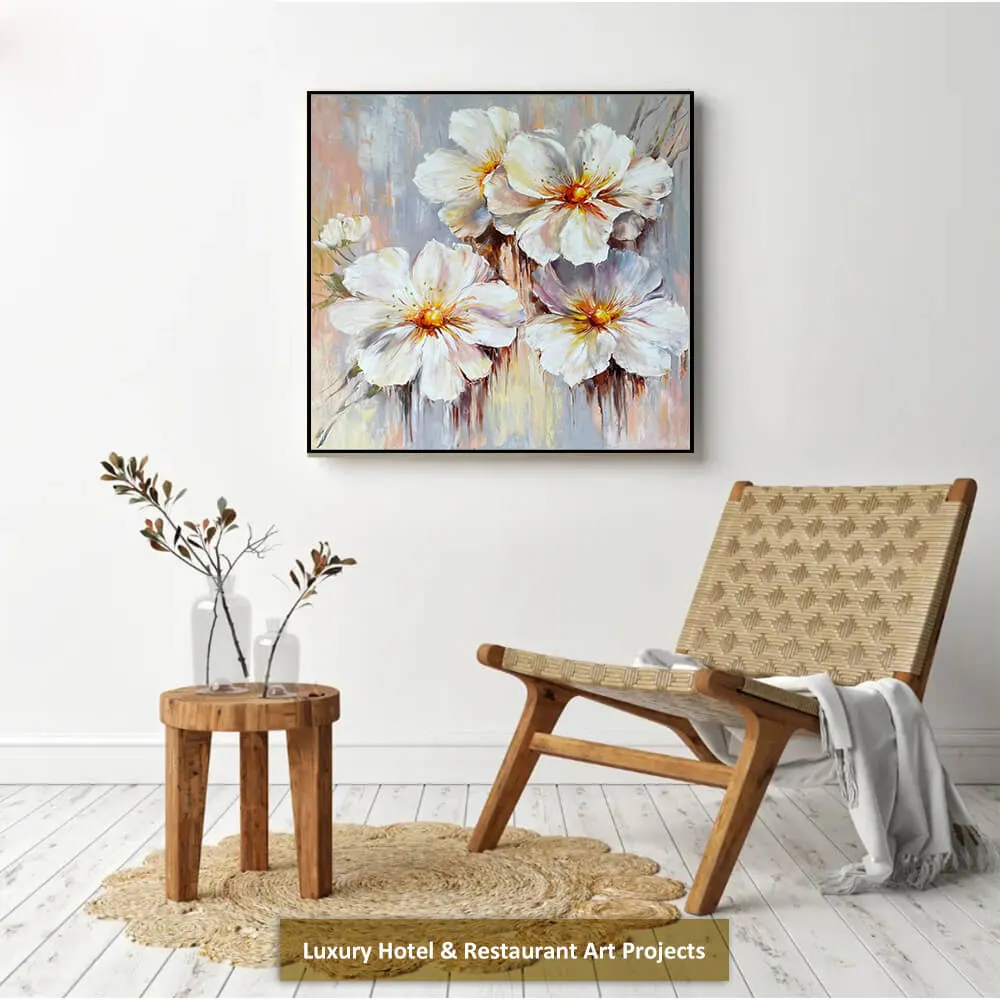
This is the category closest to popular aesthetics. Its prototype comes from real objects, which, after simplification, deformation, and blurring, still retain a faint recognizable prototype in the image.
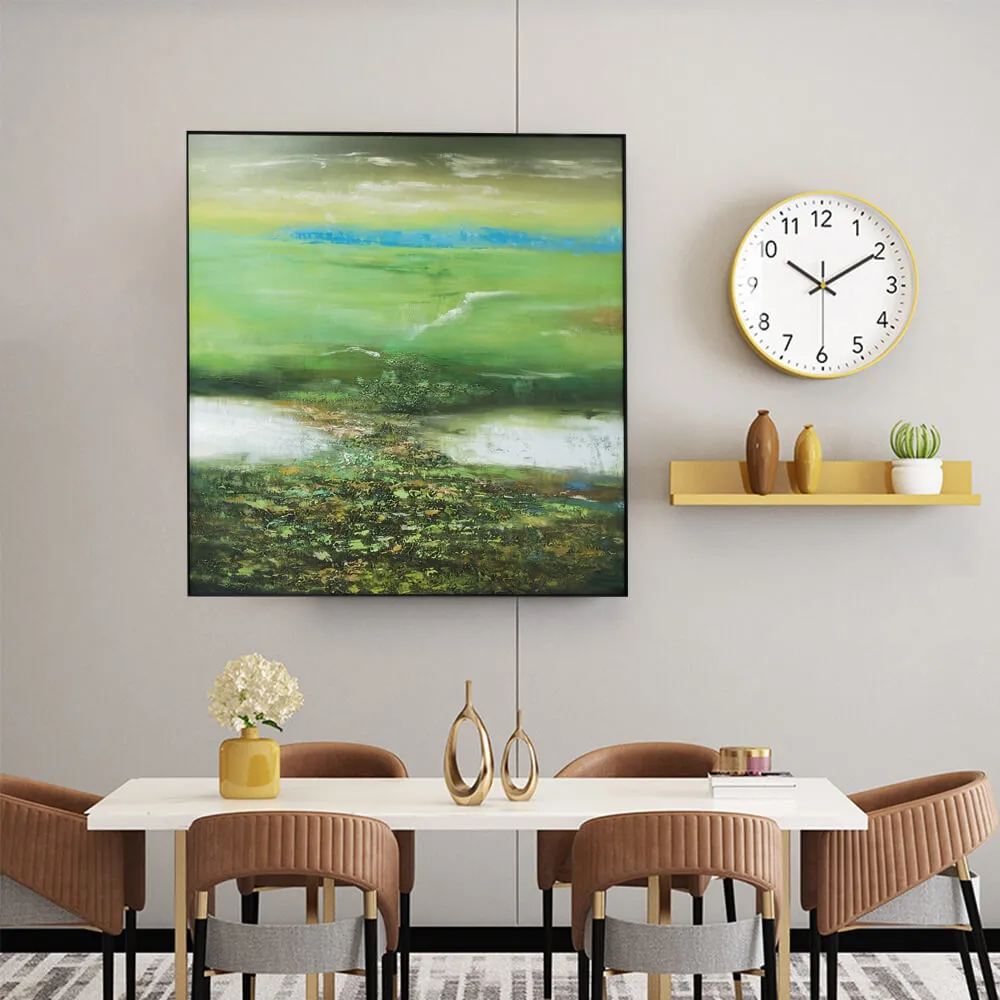
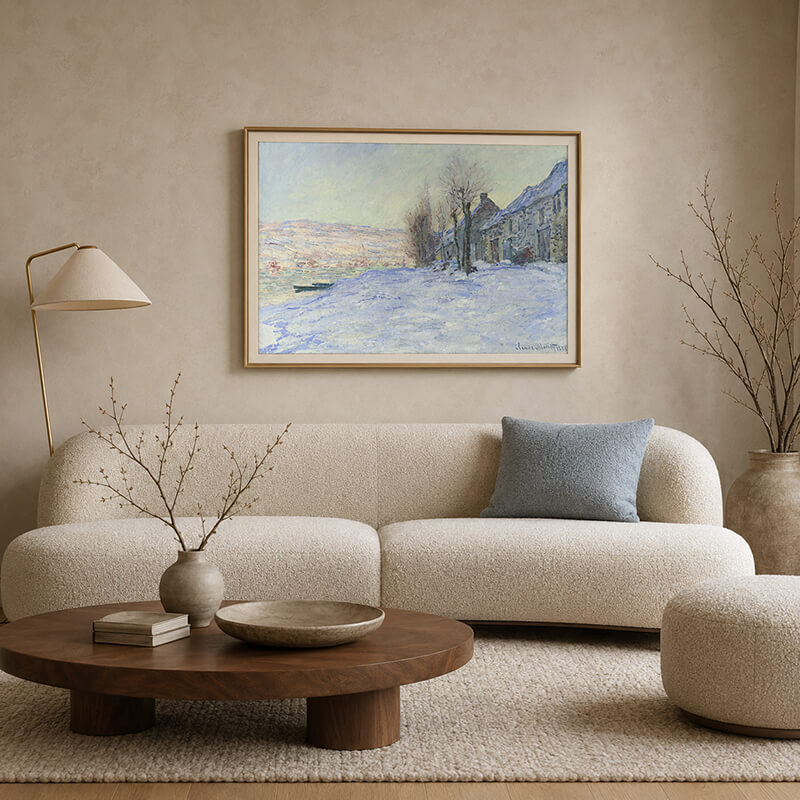
Artists extract the most essential features of the object, removing complex details and retaining only the outline and atmospheric suggestion. For example, mountains, seas, clouds, and mist are refined into flowing blocks of color, and flowers are simplified into a few strokes, creating an atmosphere that is evocative from afar and detailed up close. Features: Lowest barrier to entry; possesses the atmosphere of abstract art without being incomprehensible due to the complete absence of objects.
2. Cold Abstraction | Geometric Abstraction
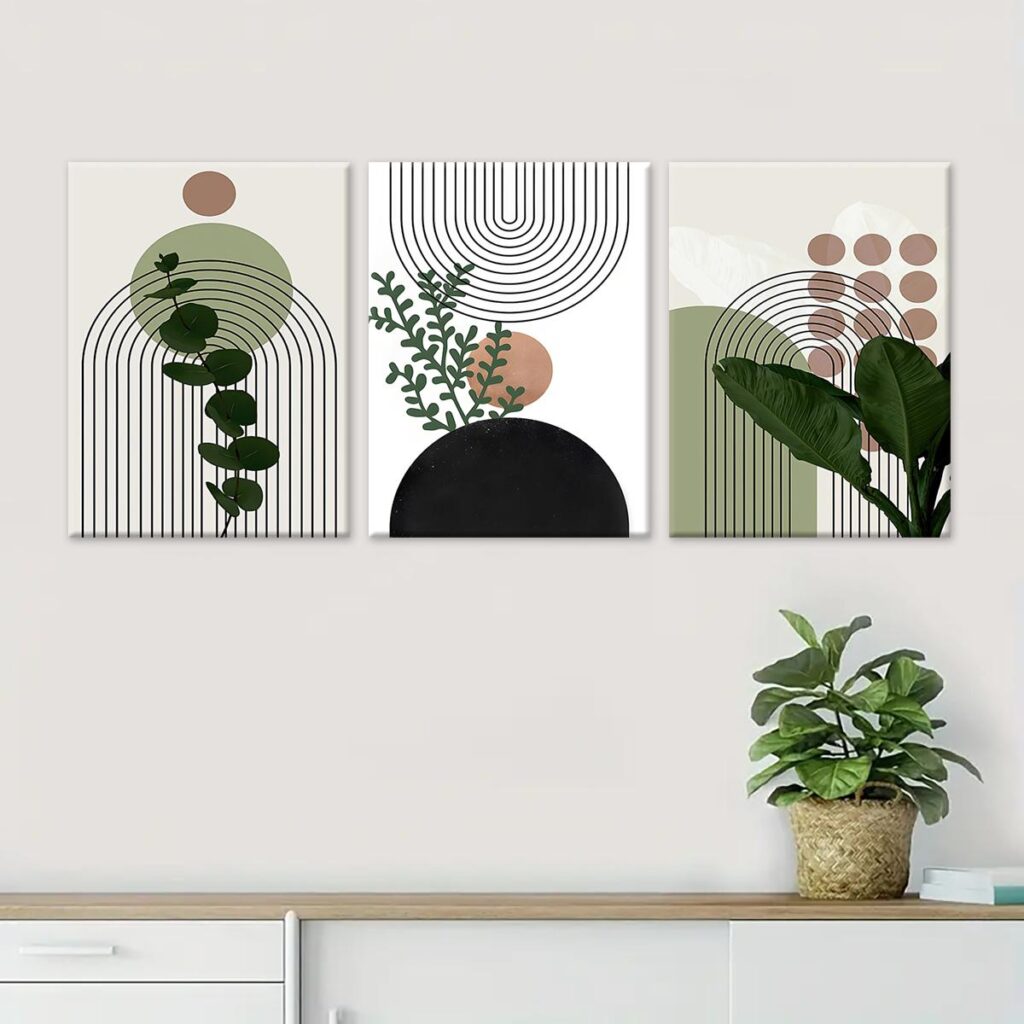
A representative of rational order. It completely abandons casual hand-drawn brushstrokes, using geometric shapes such as straight lines, rectangles, circles, and triangles as core elements. Color boundaries are clear and hard, and color blocks are clearly divided.
These works pursue balance, proportion, and a sense of mathematical order. The emotions are restrained and calm; the artist explores the harmony of form itself, rather than the venting of personal emotions.
Representative figure: Piet Mondrian, whose masterpiece Composition with Red, Yellow and Blue uses thick black lines to divide the canvas, filling it with the three primary colors and black, white, and gray, becoming a classic symbol of geometric abstraction.
Suitable scenarios: Minimalist spaces, modern offices, and light luxury commercial spaces.
3. Hot Abstraction | Lyrical Abstraction / Abstract Expressionism
A type that prioritizes emotional expression. Lines are free and unrestrained, brushstrokes are full of variation, and the picture is irregular and dynamic, a direct release of the artist’s inner feelings.
It can be further divided into two directions: Action Painting: The act of painting itself is part of the creation.
The most typical example is Pollock’s drip painting, where the canvas is laid out on the ground, and paint is created by dripping, splashing, and flicking, resulting in a painting filled with interwoven paint marks, full of dynamism and tension; Color Field Painting: Large areas of soft color blocks are applied, without strong brushstrokes, relying on the entire color to create a calm and grand mood. Mark Rothko is a representative figure.
In addition, there are several currently popular sub-styles:
Minimal Abstract: Large areas of white space, very few lines and colors, restrained and clean, and has become very popular in overseas home decoration in recent years;
Fluid Art: Paint is poured, relying on the natural flow and mixing of liquids to form textures, with soft and dreamlike color transitions;
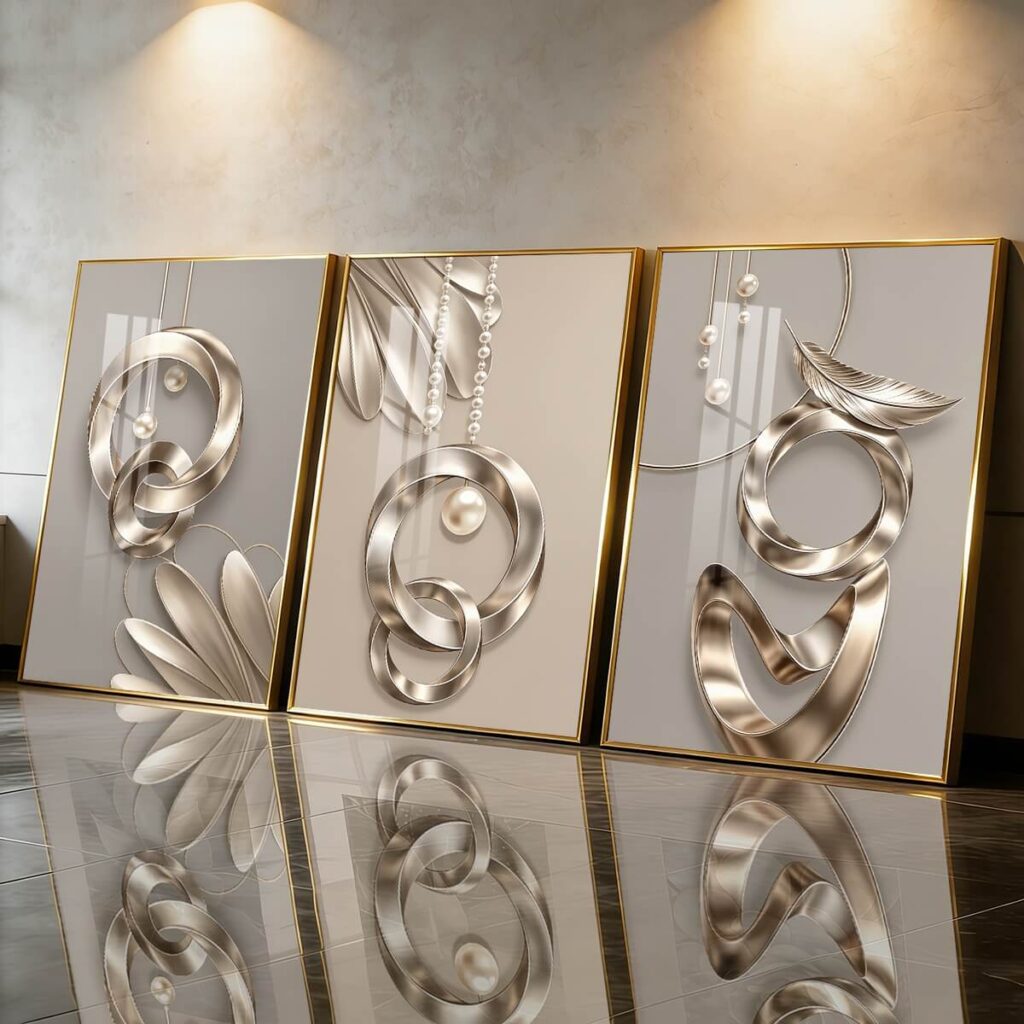
Monochrome Abstract: A single color scheme, relying on variations in shade and texture to create depth in the painting, understated and sophisticated;
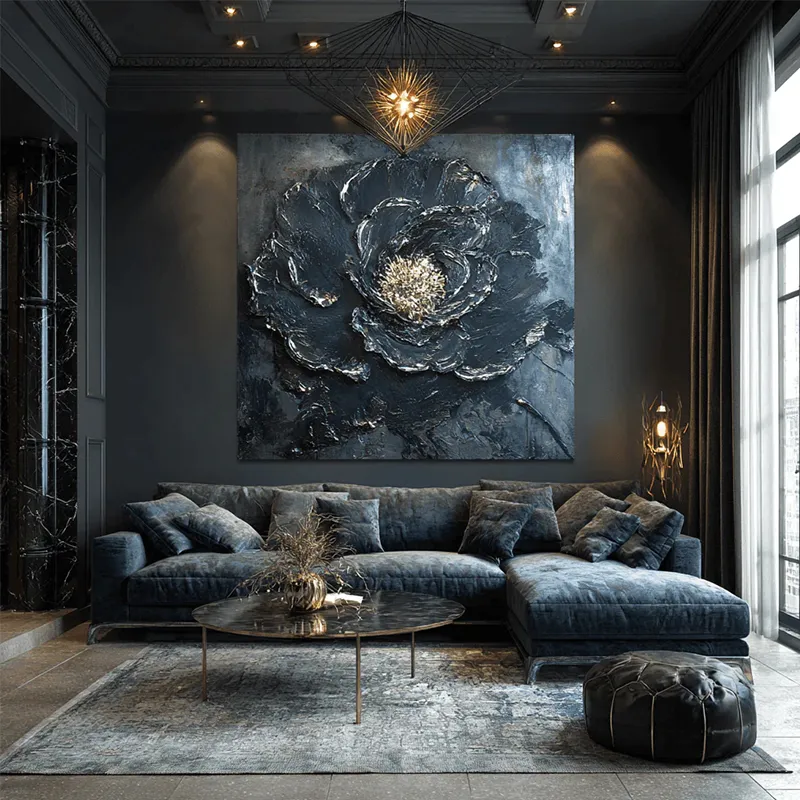
Textured Abstract: Emphasizing the texture of the painting, using thick paint, scraping, and sandy textures, resulting in a strong visual three-dimensionality.
IV. Understanding the Code of Abstract Painting: 5 Core Visual Elements
Appreciating abstract paintings doesn’t require worrying about “what it depicts.” What matters are these five dimensions:
1. Color: The Primary Emotional Carrier
Color is the most important expressive tool in abstract painting. It doesn’t need to reproduce the true colors of objects; its sole purpose is to convey emotion. For example:
- Low-saturation Morandi gray tones: tranquil and soft, suitable for Scandinavian and cream-style home decor, with the widest appeal;
- High-saturation contrasting colors: vibrant and energetic, suitable for commercial spaces and youthful homes;
- Earth tones (beige, coffee, ochre): warm and versatile, suitable for modern minimalist styles;
- Cool colors (blue, gray): calm and soothing, suitable for bedrooms, studies, and offices.
2. Lines: The Rhythmic Framework of the Image
The form of lines directly determines the mood of the image:
- Straight lines: bring stability, strength, and a sense of order, most commonly used in geometric abstraction;
- Smooth curves: convey a soft, flowing, and relaxed feeling;
- Fragmented, intersecting, and trembling lines: create a sense of restlessness, tension, and conflict.
3. Shape and Form: The Visual Focal Point
Regular geometric shapes (circles, squares): Stable, orderly, and inherently possessing a sense of order; Organic irregular forms: Natural, free-flowing, and more vibrant.
4. Texture: The Source of Sophistication
Texture refers to the surface texture of the painting, and is key to elevating the quality of decorative paintings.
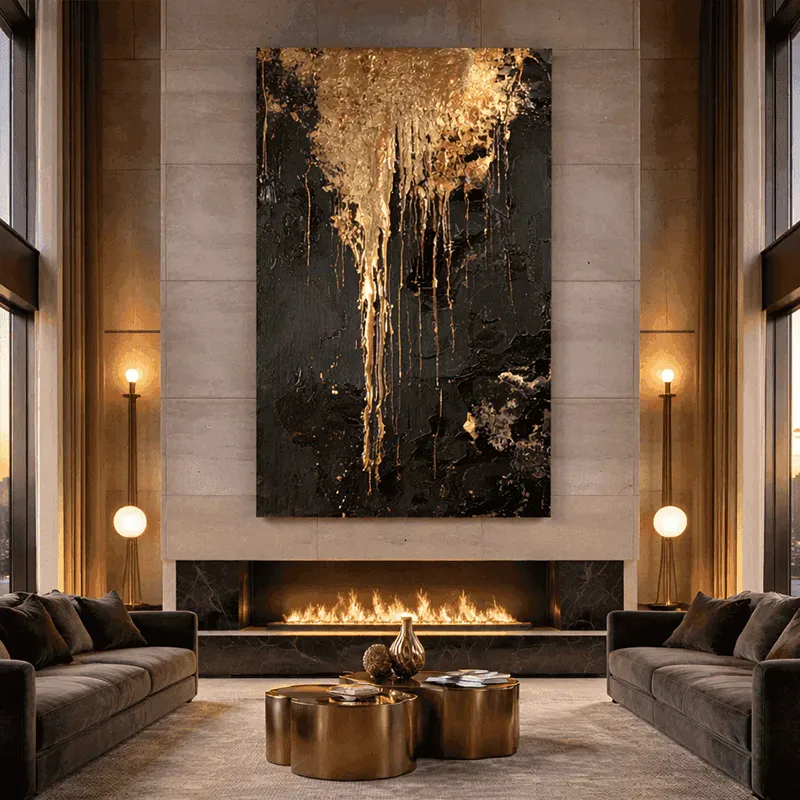
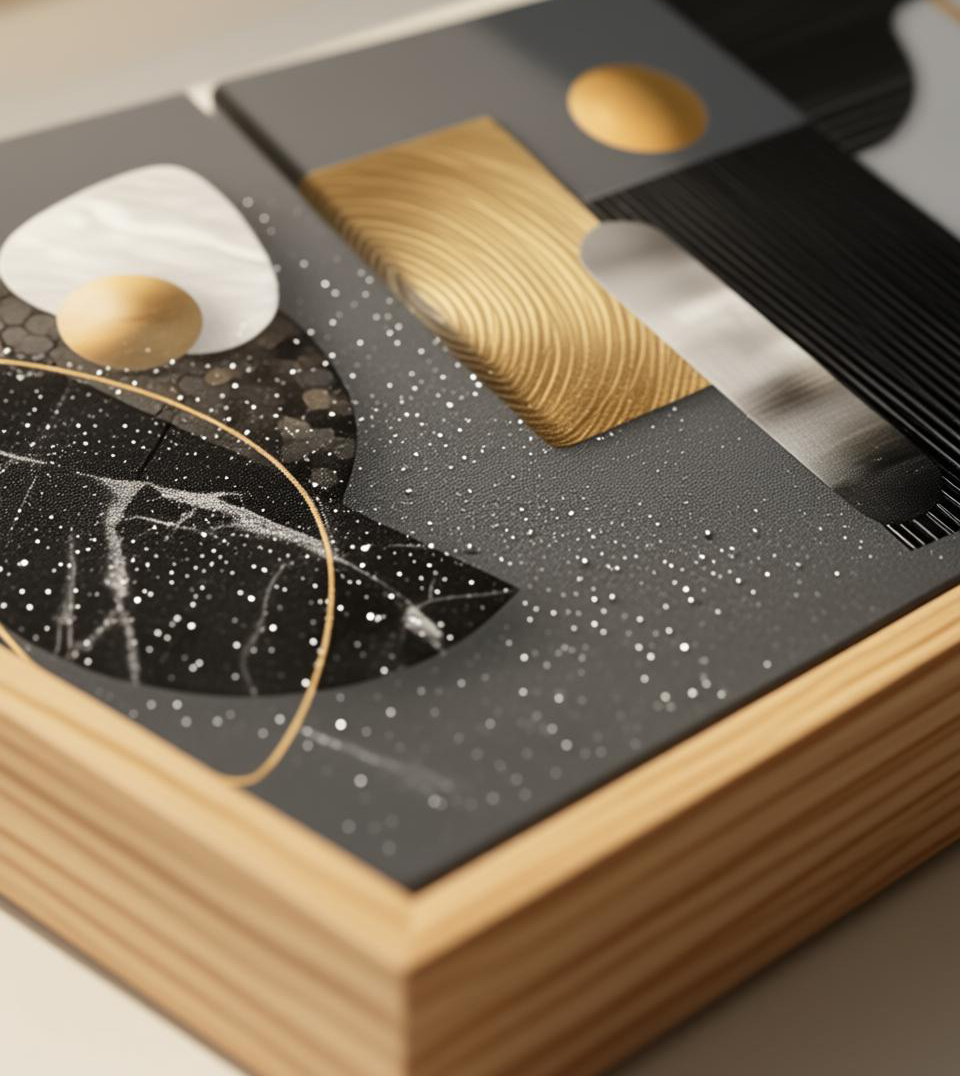
Impasto: Thick layers of paint are applied to the canvas, creating a textured surface with strong three-dimensionality under light and shadow; a popular technique in decorative painting.
Scratched texture: Sharp lines are created by scraping paint with a palette knife, resulting in a strong sense of texture.
Splatter texture: Fine, scattered paint spots, free and lively.
Printed replica texture: The visual effect of impasto is simulated through digital printing; a common solution for mass-produced decorative paintings.
5. Composition and Space: The Invisible Balance
Abstract paintings still strictly adhere to the principles of composition: visual balance, contrast between density and sparseness, negative space, and visual equilibrium are all indispensable. Even without figurative objects, the composition guides the viewer’s eye. Centralized composition: stable and grand; Asymmetrical balance: dynamic and modern; Large areas of white space: bring a sense of breathing space, the essence of minimalism.
V. Three common misconceptions about abstract painting
Misconception 1: Abstract painting is just random scribbling, lacking technical skill.
Truth: The more casual a work appears, the more control it often requires.
The difficulty of splashing paint and thick application in abstract painting lies in controlling the proportions of colors, the center of gravity of the image, and the rhythm of density—too much color makes it chaotic, too little makes it thin. Geometric abstraction requires even more precise calculation of proportions.
Abstract painting does not test realistic modeling ability, but rather the control of color, balance, and visual rhythm. Many abstract artists possess solid realistic skills; they simply choose to abandon realism, not because they cannot paint.
Misconception 2: Abstract paintings have no theme; if you can’t understand it, it’s badly painted.
Truth: The “theme” of abstract painting is not necessarily a person, story, or landscape. Its themes can be the flow of wind, a state of tranquility, a sense of power, the passage of time, or even simply the beauty of color clashes.
To appreciate abstract paintings, you don’t need to force yourself to find corresponding real objects in the picture.
The correct approach is: observe the overall atmosphere from a distance, feeling the emotions conveyed by the colors; examine the brushstrokes and textural details up close. There is no single correct answer; your own feelings are the best interpretation.
Misconception 3: All modern art is abstract painting.
Truth: Modern art is a vast collection, and abstraction is only one branch. Surrealism, Pop Art, and other movements still depict representational images and do not belong to the category of abstract art.
VI. How to match abstract paintings in the home to make it look good?
The biggest advantage of abstract paintings in home decoration is their versatility; they are not limited by furniture style. Unlike portraits and realistic landscapes, which are demanding in terms of decorating style, abstract paintings can be found for almost any style, including modern minimalism, Scandinavian, understated luxury, wabi-sabi, and industrial styles.
Choosing the Right Artwork for Different Scenarios
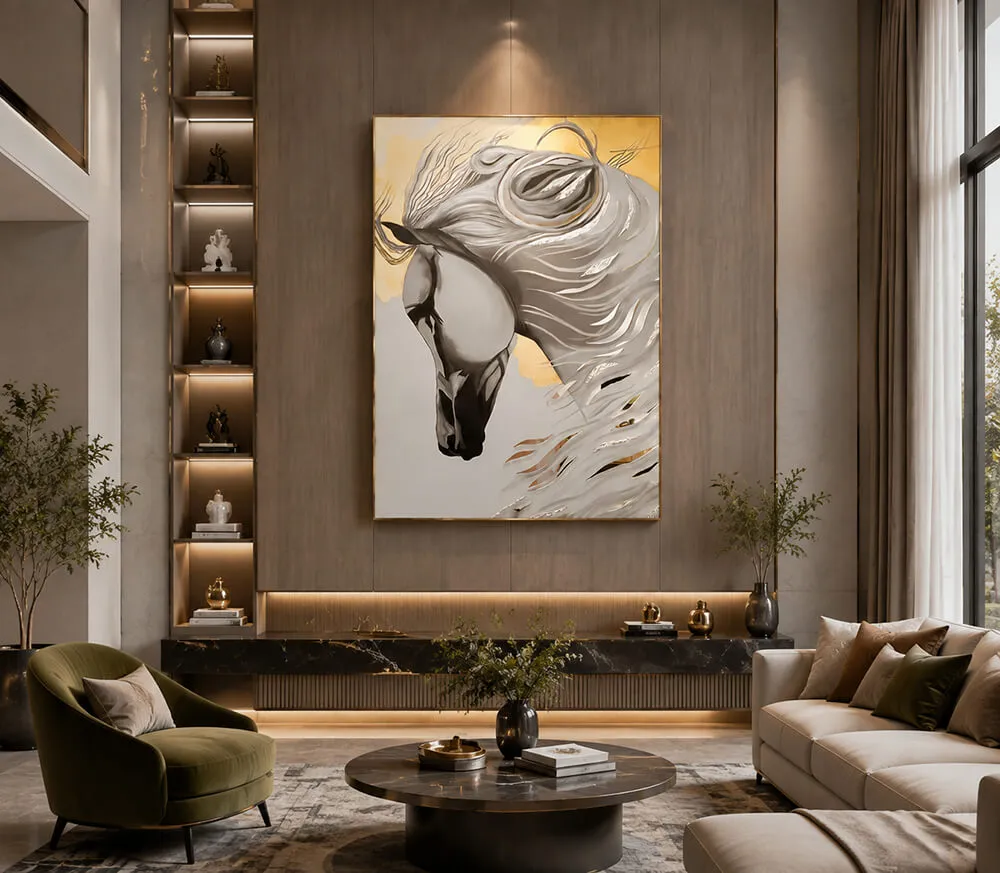
Living Room Sofa Background Wall: Prioritize large-format abstract paintings. Textured and large-block color designs are suitable, quickly becoming the visual focal point and enhancing the ambiance of the space.
Bedroom & Dining Room: Medium-sized abstract paintings are preferable, prioritizing low-saturation, soft styles to create a relaxing atmosphere.
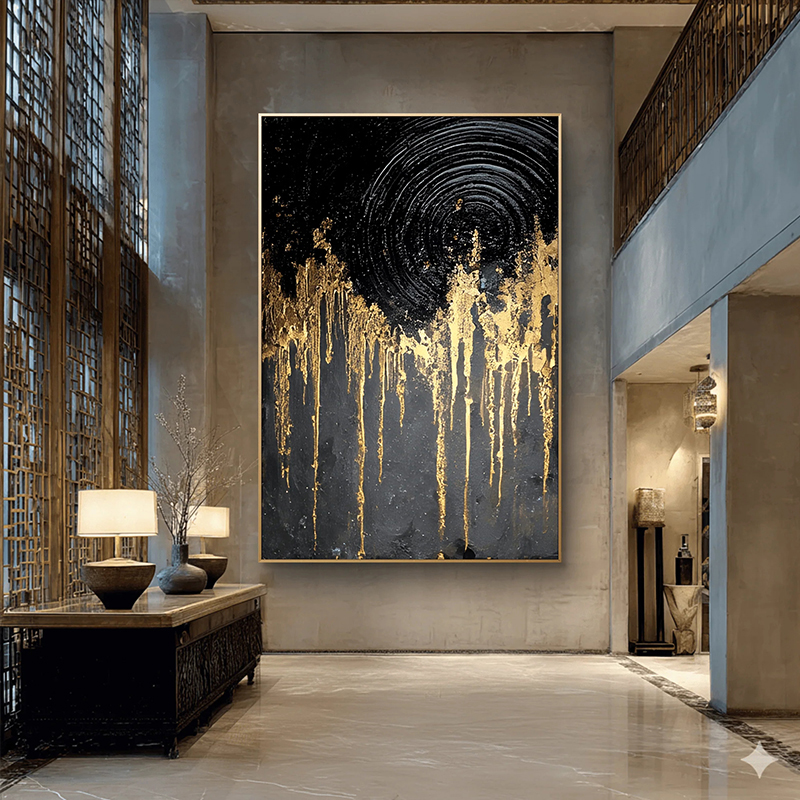
Entrance Hall & Hallway: Vertical abstract paintings can guide the eye.
Gallery Wall: Combining multiple small abstract paintings is a popular and flexible way to decorate a home, adding depth and dimension.
Size Recommendations for Decorative Paintings
Extra-large (70cm+): Suitable for spacious main walls, creating a strong sense of atmosphere. Medium-sized: Suitable for bedrooms, dining rooms, and other regular spaces. Small paintings: Suitable for combination paintings or filling small blank walls.
There’s never a standard answer to appreciating abstract art. It’s more like a piece of music without lyrics, without a single “correct interpretation.” The peace, passion, and relaxation you experience are all part of its meaning.