Monet’s New Artistic Life in Giverny
Monet settled in Giverny in 1883. The surrounding fields gave him direct access to changing skies, seasonal colors, and rural vegetation. According to the Musée de l’Orangerie, this period later inspired his celebrated series of haystacks, poplars, and water lilies.
However, Monet did not treat nature as a fixed subject. Instead, he studied how light altered every visible surface. A field could appear cool and quiet in one moment, then vivid and animated in the next.
This painting predates his mature Water Lilies cycle. Therefore, it reveals how the fields around Giverny prepared the way for his later garden paintings.
Exploring Claude Monet’s Field of Yellow Irises at Giverny (1887)
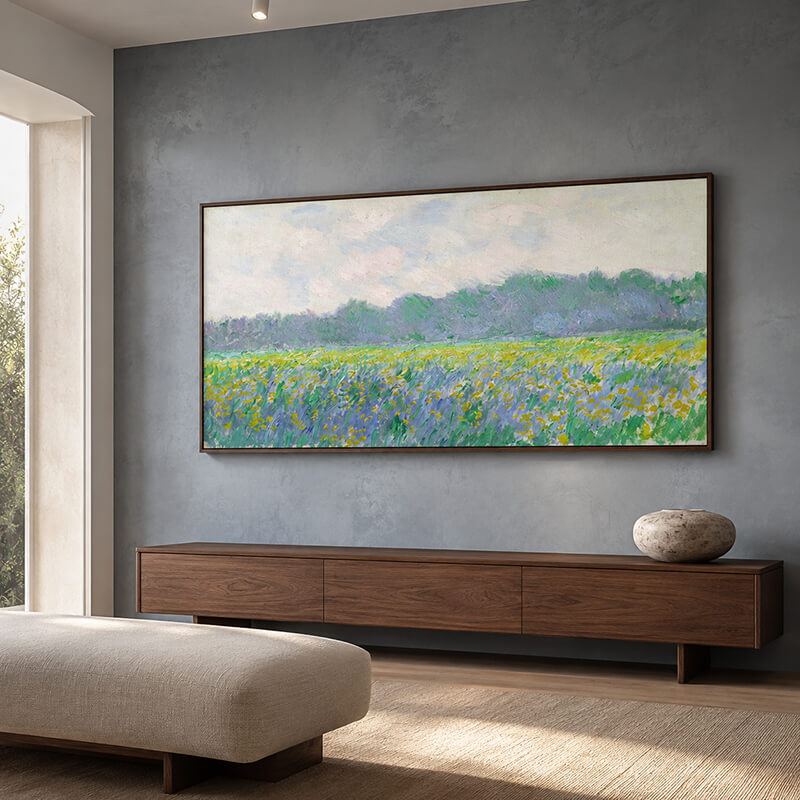
A breeze seems to move through the flowers and grasses. In Field of Yellow Irises at Giverny, Claude Monet transforms a simple rural landscape into an energetic study of light, color, and atmosphere.
Painted in 1887, the work belongs to a decisive period in Monet’s career. By then, the countryside around Giverny had become both his home and an enduring source of inspiration.
The Color Structure of Field of Yellow Irises at Giverny
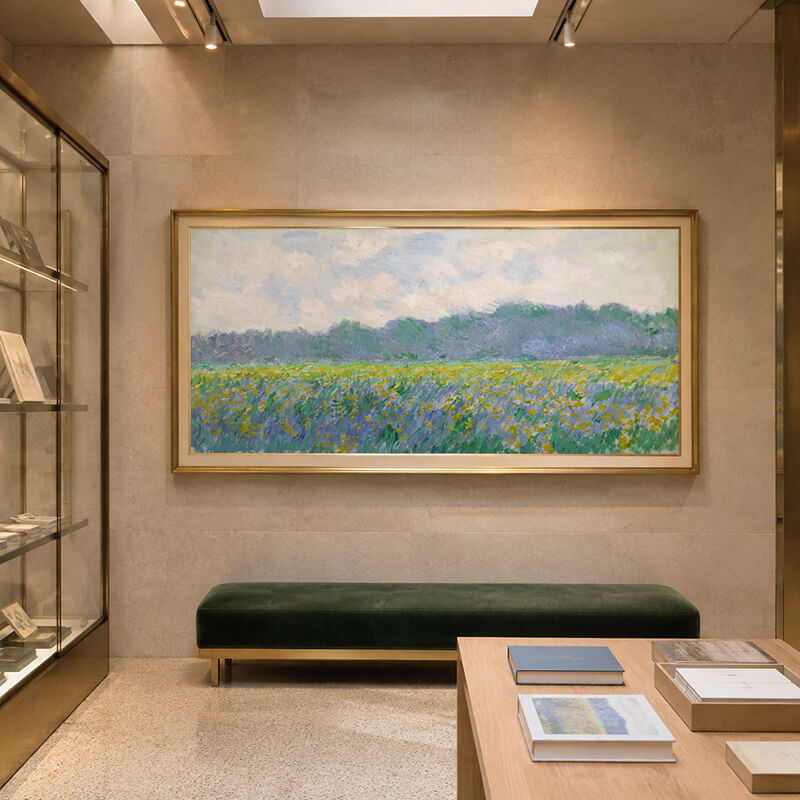
Yellow flowers spread across the foreground in irregular, rhythmic clusters. Meanwhile, blue and violet grasses surround them. This complementary contrast intensifies both colors without making the composition feel artificial.
The distant trees form a cool green and lavender band. Above them, the pale sky creates visual space and softens the stronger colors below. As a result, the field appears expansive and filled with fresh air.
In Field of Yellow Irises at Giverny, color does more than describe individual plants. It communicates sunlight, temperature, movement, and distance.
Monet’s short, slightly angled brushstrokes also create energy. They suggest grasses bending in the wind and flowers moving across the field. Furthermore, the visible marks prevent the surface from becoming static or overly detailed.
A Panoramic View of the French Countryside
The painting uses a low horizon and an unusually wide composition. Consequently, viewers feel positioned directly in front of the flower-filled landscape.
Monet avoided a single dominant object. Instead, the repeated flowers and brushstrokes guide the eye horizontally across the canvas. This approach creates a panoramic experience rather than a traditional landscape with one central focal point.
The irises also serve a broader artistic purpose. Their yellow petals capture light, while the surrounding blue-green tones convey shadow and atmosphere. Therefore, the plants become instruments through which Monet explores perception itself.
Bringing Impressionist Color into Modern Interiors
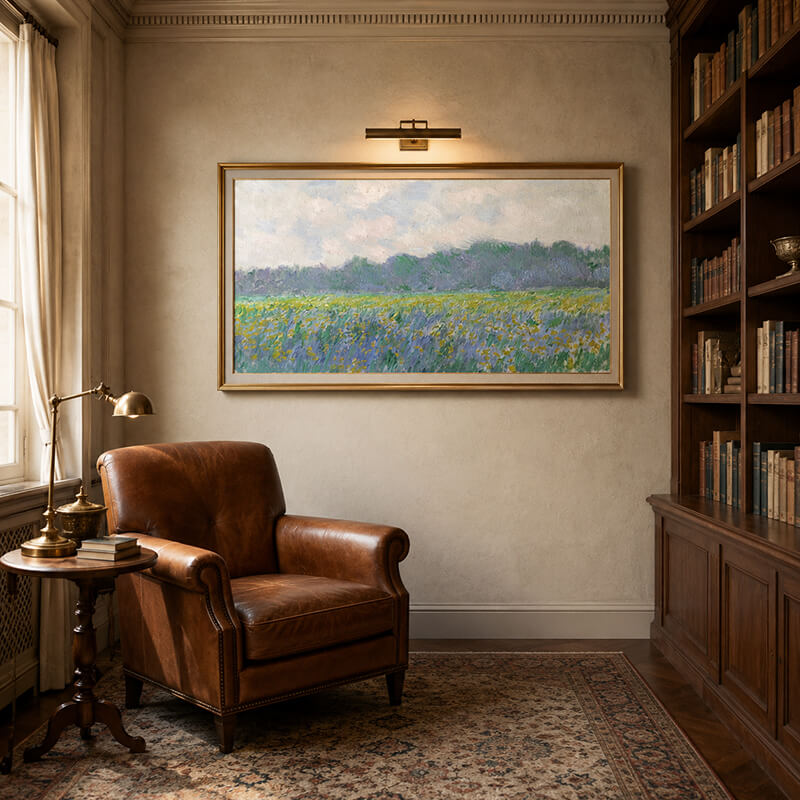
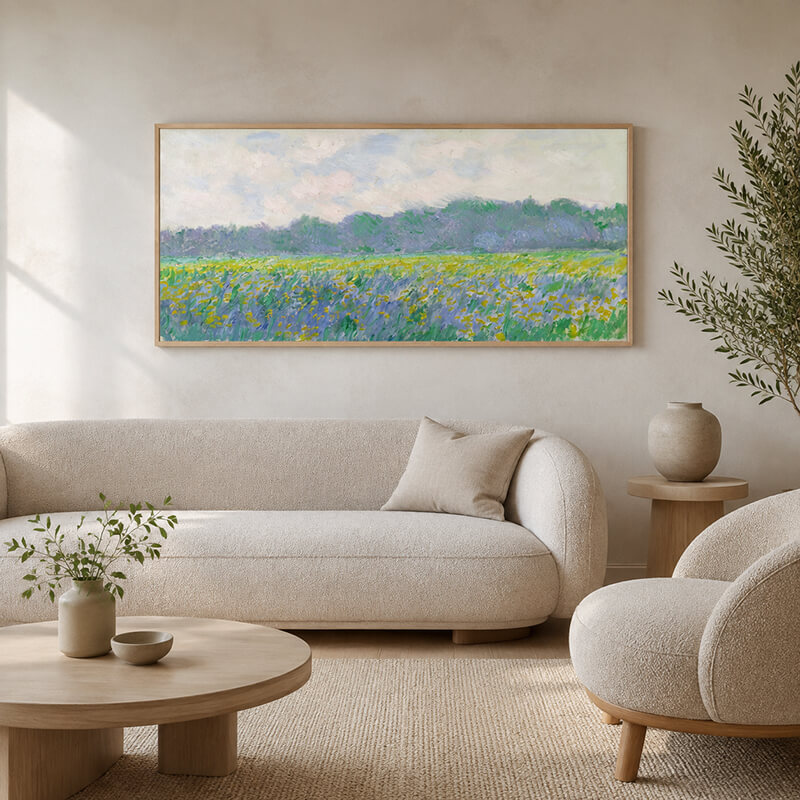
A reproduction of Field of Yellow Irises at Giverny works especially well in French country, natural vintage, and modern minimalist interiors. Its yellow accents introduce warmth, while the blue-green palette maintains a calm atmosphere.
In a living room, the painting can create a refreshing focal point above a cream, beige, or pale gray sofa. In addition, it brings gentle color to a study or a naturally lit dining room. Light wood, antique gold, or walnut frames can strengthen its relationship with surrounding furniture.
For more design and sourcing options, explore our collection of Impressionist oil paintings. Custom sizing and framing can help the artwork suit residential, hospitality, and commercial projects.
Rather than functioning as ordinary decoration, the painting offers unique wall décor with historical character and lasting visual appeal.
A Landscape That Continues to Breathe
Field of Yellow Irises at Giverny captures more than a flower-filled field. It preserves a fleeting encounter between sunlight, wind, color, and human perception.
More than a century later, the landscape still feels immediate. Its balance of brightness and calm allows Monet’s vision of nature to remain both timeless and deeply relevant.