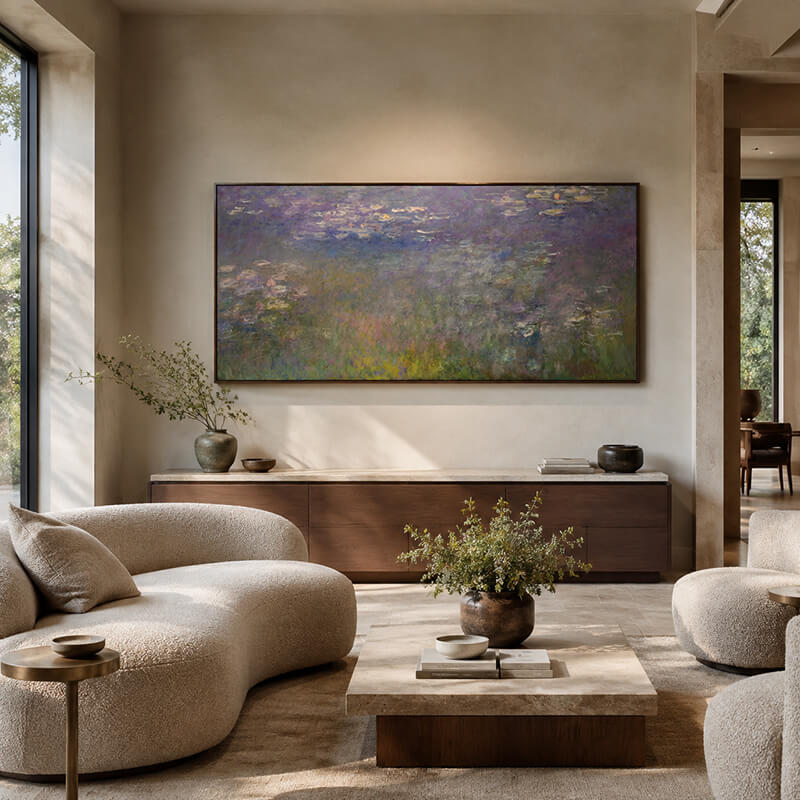
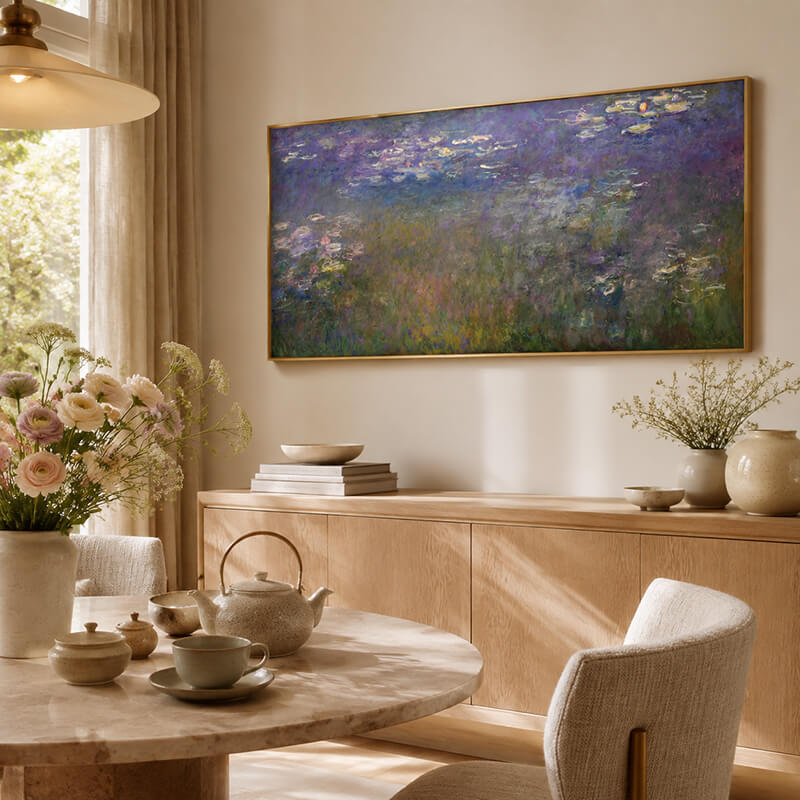
At his garden in Giverny, Claude Monet transformed a private pond into one of the most influential subjects in modern art. The Claude Monet Water Lilies painting, created between 1915 and 1926, combines violet, blue, green, and muted gold in an expansive vision of water, light, and reflection.
Claude Monet Water Lilies Painting: Color, Scale, and Enduring Influence
Rather than presenting a conventional landscape, Monet removed the horizon and allowed the pond to fill the entire composition. As a result, viewers do not simply observe the garden. Instead, they appear to enter a continuous field of color and movement.
A Horizonless Revolution in Monet’s Water Lilies
In the Claude Monet Water Lilies painting, the water acts as both surface and space. Reflections of clouds, plants, and changing light merge without a fixed foreground or background. Therefore, the composition feels open-ended and capable of extending beyond the canvas.
Deep violet and misty blue establish a quiet foundation. Meanwhile, green vegetation and small touches of yellow create rhythm across the surface. These colors do not describe every physical detail. Instead, they communicate the changing sensation of light.
Monet’s late brushwork also became broader and more expressive. Although his cataracts affected his vision, his artistic decisions cannot be explained by illness alone. His increasingly abstract approach helped connect Impressionism with later developments in modern painting. The Musée de l’Orangerie’s history of the Water Lilies cycle explains how the project occupied Monet for almost three decades.
Persistence, War, and the Grandes Décorations
Monet developed these monumental works during a difficult period marked by the First World War, personal loss, and declining health. However, he continued observing the pond and refining his canvases. For him, painting remained both a discipline and a form of emotional refuge.
In 1915, Monet built a large studio at Giverny to accommodate the vast panels he called the Grandes Décorations. According to MoMA’s Water Lilies gallery presentation, he produced more than 40 large-scale panels between 1914 and 1926.
Moreover, Monet offered a group of Water Lilies panels to the French state as a symbol of peace after the 1918 Armistice. They were later installed in the Musée de l’Orangerie, where their curved arrangement created an immersive environment rather than a conventional exhibition.
Styling Monet’s Water Lilies Canvas Art at Home
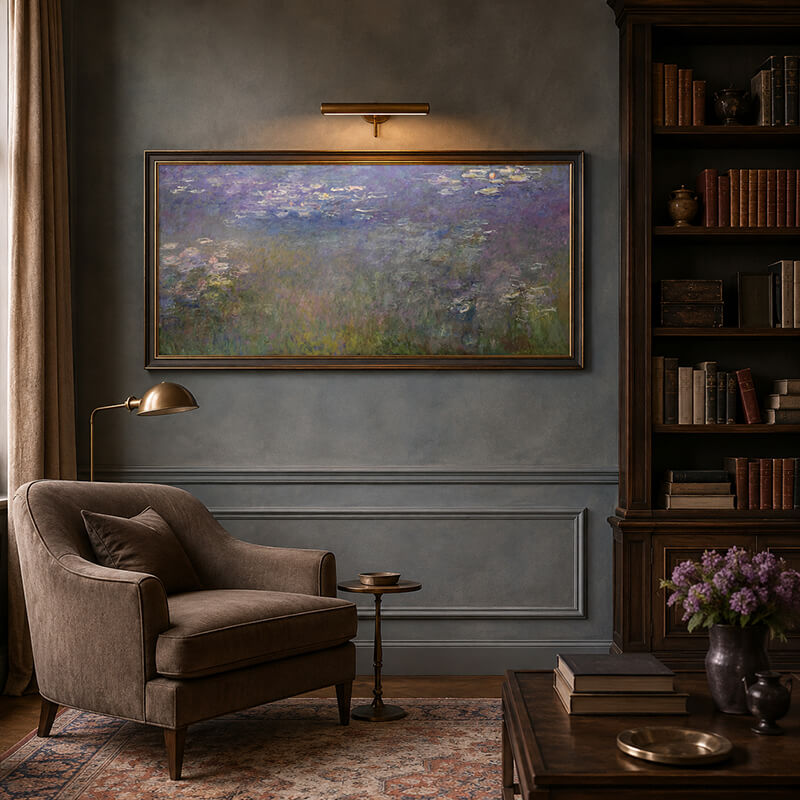
The Claude Monet Water Lilies painting works especially well in modern minimalist, French Provincial, contemporary, and restrained Asian-inspired interiors. Its panoramic format is suitable above a sofa, console, dining table, or hotel reception desk.
For a coordinated palette, select two or three colors from the artwork. Violet cushions, muted green curtains, blue-gray rugs, or antique brass accessories can create a subtle connection. However, avoid matching every object to the painting. Neutral walls and natural wood allow the artwork to remain the focal point.
A canvas wrap preserves Monet’s borderless sense of space. Alternatively, a narrow matte-gold frame adds classical refinement, while a dark wood or black frame creates stronger contrast. For more placement ideas, explore our wall art painting guide for residential and commercial spaces.
Collectors and designers can also browse our Impressionist landscape wall art collection for custom sizes and framing options. With thoughtful scale and restrained styling, Monet-inspired art becomes unique wall décor rather than a simple decorative accessory.
Bring the Atmosphere of Giverny Into Your Space
The Claude Monet Water Lilies painting represents more than a garden pond. It expresses patience, reflection, and an enduring search for beauty. Choose a size and frame that complement your interior, and let its layered colors create a calm, artistic focal point in everyday life.