Few paintings capture the atmosphere of a summer garden as vividly as Monet Woman with a Parasol in a Garden. Created in Argenteuil in 1875, the work places an elegantly dressed woman among dense foliage and bright flowers. Rather than recording every detail, Claude Monet transforms sunlight, movement, and color into the true subjects of the painting.
How Monet Transformed a Garden Scene Through Light and Color
The painting appears calm at first. However, its broken brushwork and shifting colors create constant visual movement. Flowers seem to flicker in the sun, while the woman’s pale dress reflects the colors surrounding her. Consequently, the figure and garden feel connected rather than separate.
A Summer Moment in Monet’s Argenteuil Garden
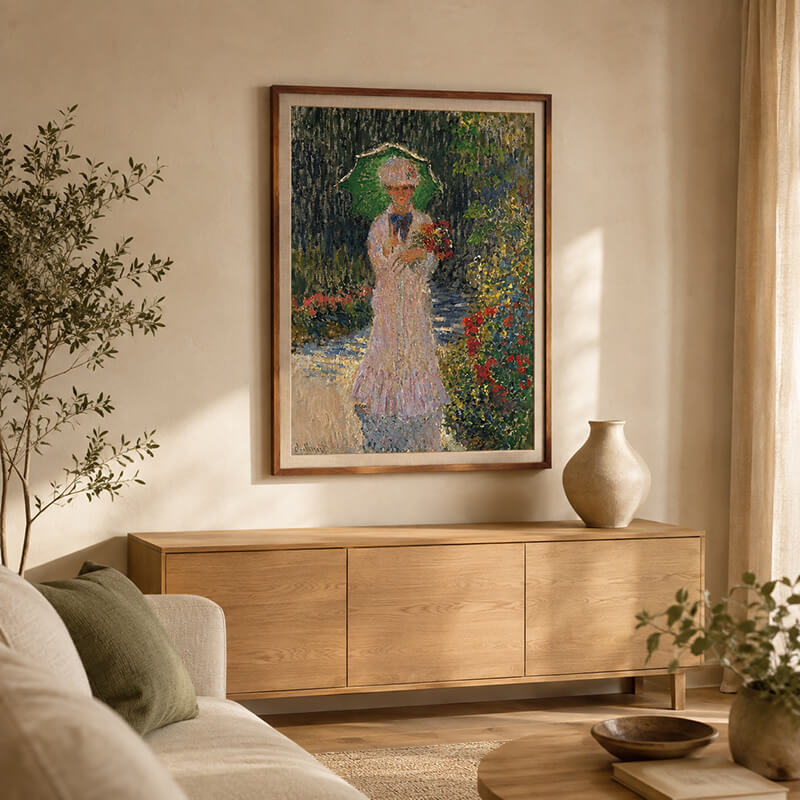
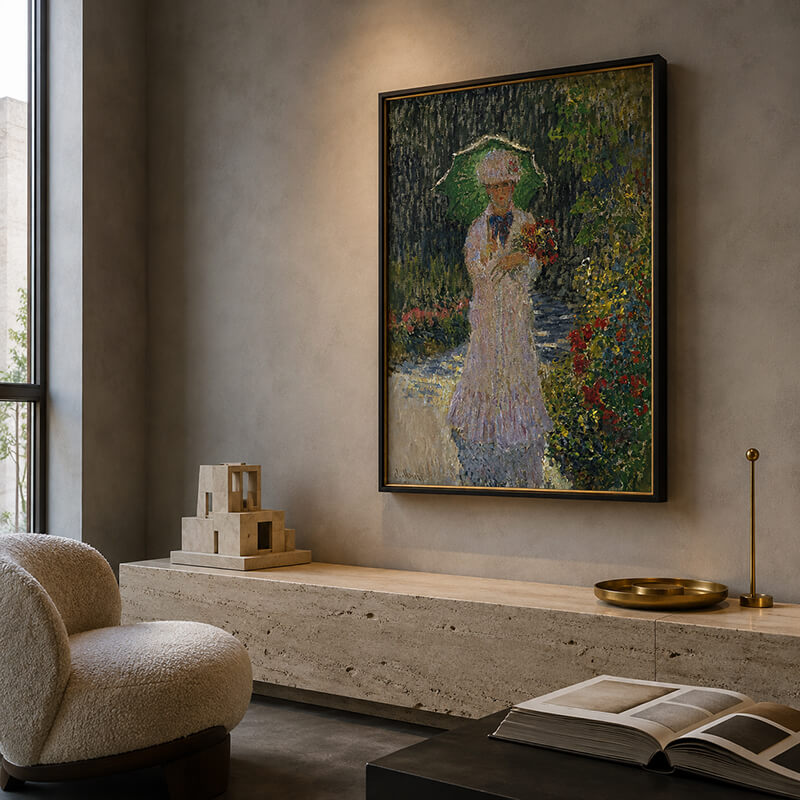
The work is generally identified as a portrait of Monet’s wife, Camille, standing in the family garden at Argenteuil. She holds a bouquet beneath a green parasol, surrounded by red flowers and shadowed foliage.
The composition feels personal but never formal. Instead of presenting Camille as a conventional portrait subject, Monet allows her figure to merge gently with the garden.
The Parasol as a Visual Anchor
The green parasol immediately attracts attention. Its strong shape frames Camille’s head and separates her pale figure from the dark background. At the same time, its emerald color echoes the surrounding leaves.
Moreover, the parasol explains the soft shadow across Camille’s face. Monet avoids sharp contrasts. Instead, he builds a gradual transition between sunlight, reflected color, and shade. The result feels natural and atmospheric.
Reading Monet Woman with a Parasol in a Garden
Complementary Colors
Monet balances the emerald parasol and dark foliage with red and orange flowers. Meanwhile, the dress contains subtle touches of lavender, pink, blue, and cream. These colors prevent the fabric from appearing flat or purely white.
The pale figure also creates a clear vertical focus. In contrast, the surrounding garden is formed from irregular areas of color, giving the composition both structure and energy.
Broken, Animated Brushwork
Short and fragmented brushstrokes describe leaves, flowers, fabric, and sunlight. Although individual marks appear loose, they become coherent when viewed from a distance.
This technique also suggests movement. The flowers appear to tremble, the dress seems touched by a breeze, and the sunlight feels temporary. Therefore, Monet records an impression of the moment rather than a fixed photographic image.
Shadows Made from Color
Traditional academic painters often created shadows with brown or black pigments. Monet takes a different approach. He layers blue, violet, green, and muted gray to create shadows that remain luminous.
As a result, even the darker parts of the garden contain atmosphere. The shaded background strengthens the brightness of Camille’s dress without making the composition feel harsh.
Why This Argenteuil Painting Matters
Monet’s Argenteuil period was central to the development of Impressionism. During these years, he repeatedly studied gardens, family life, changing weather, and modern leisure.
This painting combines those interests within one intimate scene. It demonstrates how an everyday subject could become an exploration of perception. In addition, the work shows Monet treating the human figure and the surrounding landscape as parts of the same visual experience.
Bringing Monet’s Garden Palette into Modern Interiors
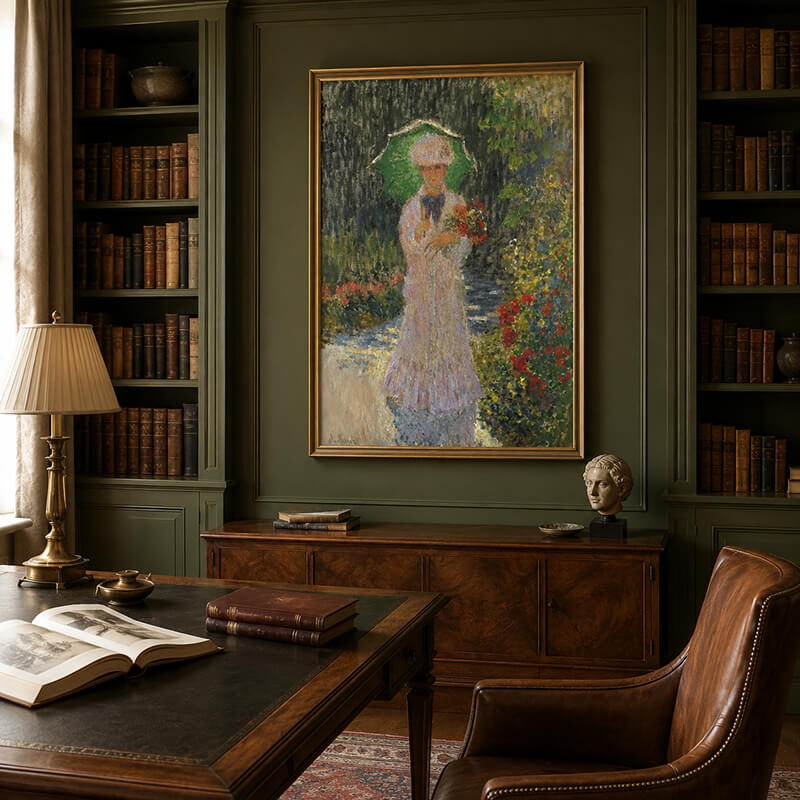
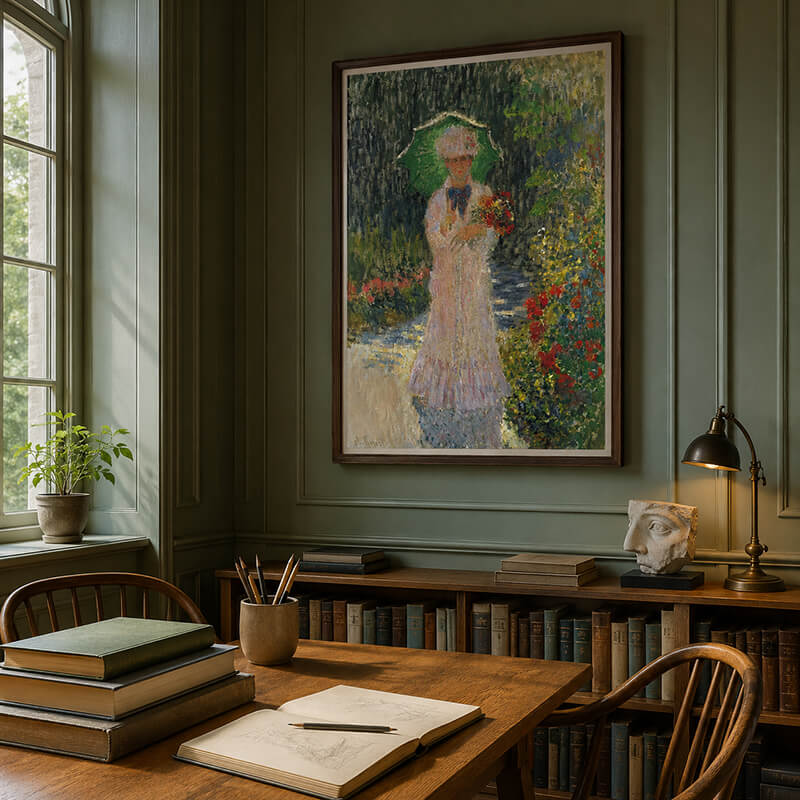
The painting offers a refined palette for interior design: emerald green, soft cream, pale lavender, muted yellow, and floral red. These colors work especially well with warm wood, ivory textiles, antique brass, and sage-painted walls.
A framed reproduction can become unique wall décor in a French-inspired living room, traditional library, warm minimalist interior, or professional design studio. A slim walnut frame creates a contemporary effect, while an antique-gold frame strengthens its historical character.
Buyers interested in related styles can explore Wallartura’s collection of Impressionist oil paintings or view another Monet garden painting reproduction for additional interior inspiration.
Ultimately, Monet Woman with a Parasol in a Garden remains compelling because it feels immediate. Through color, broken brushwork, and reflected light, Monet turns a private garden moment into a timeless study of summer atmosphere.