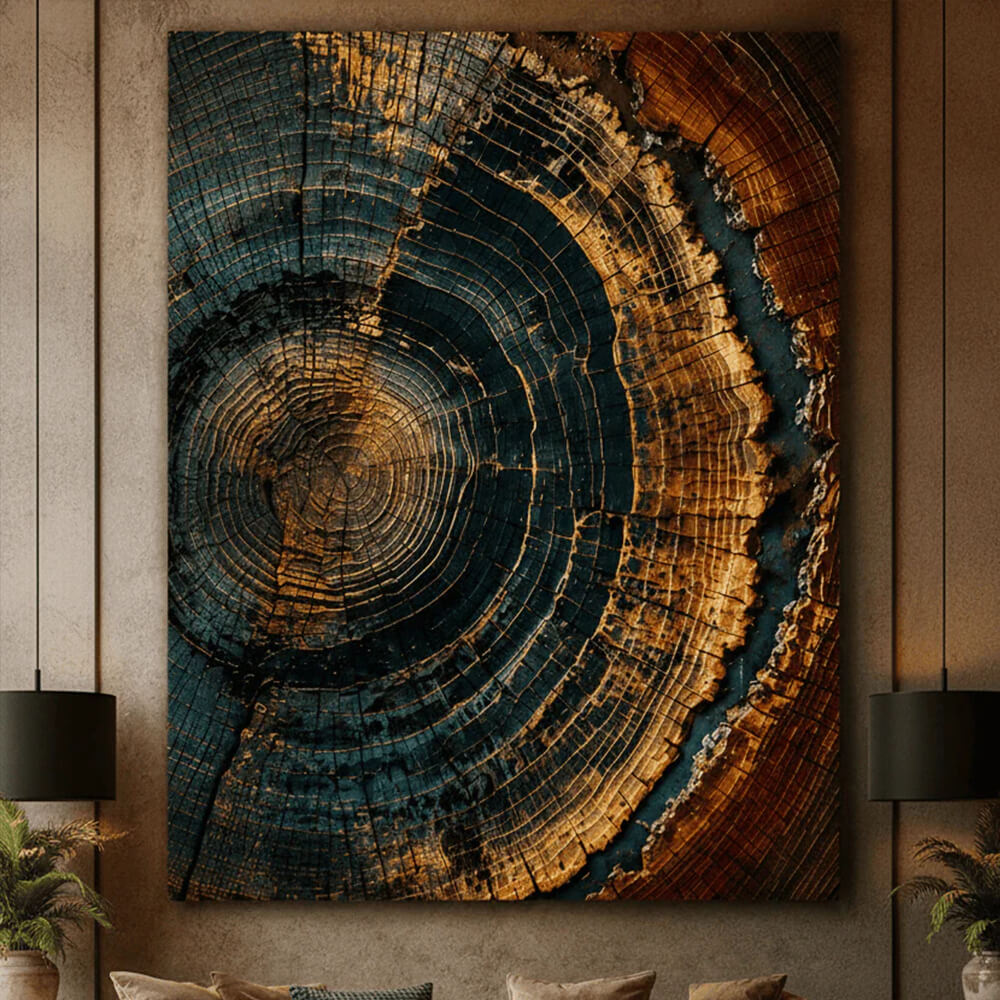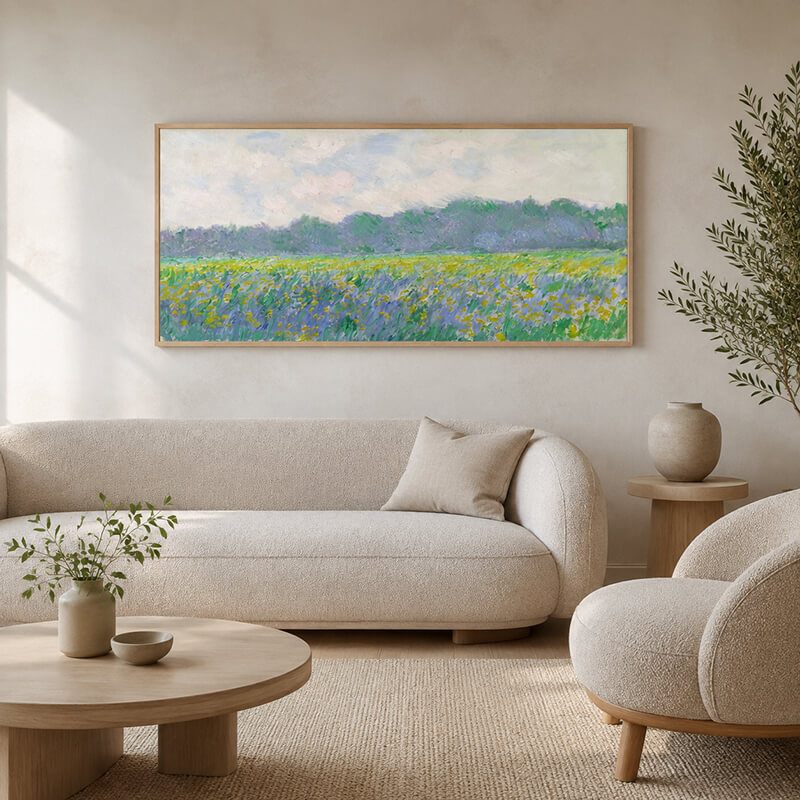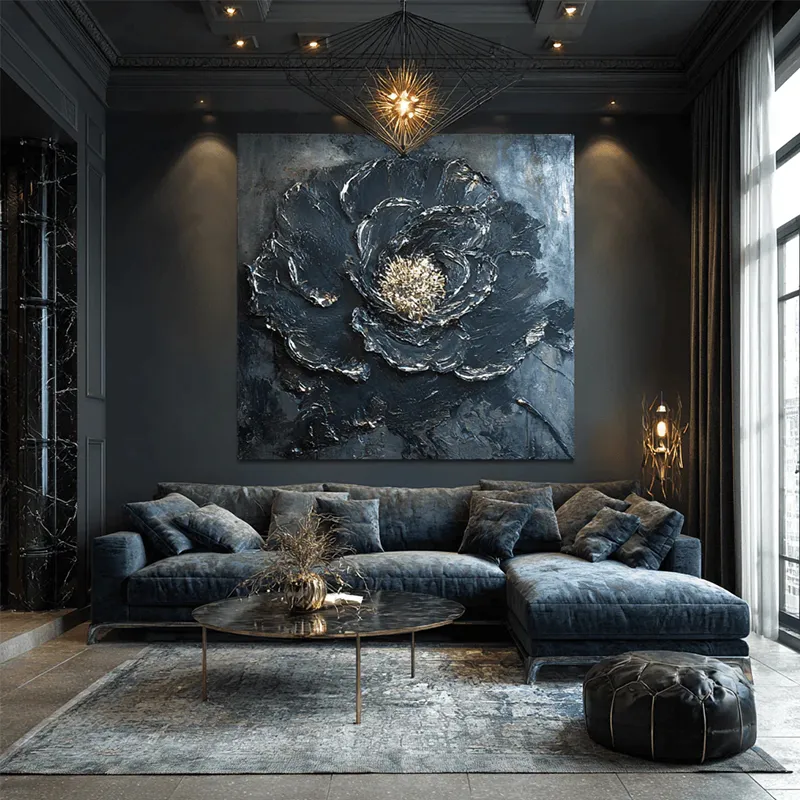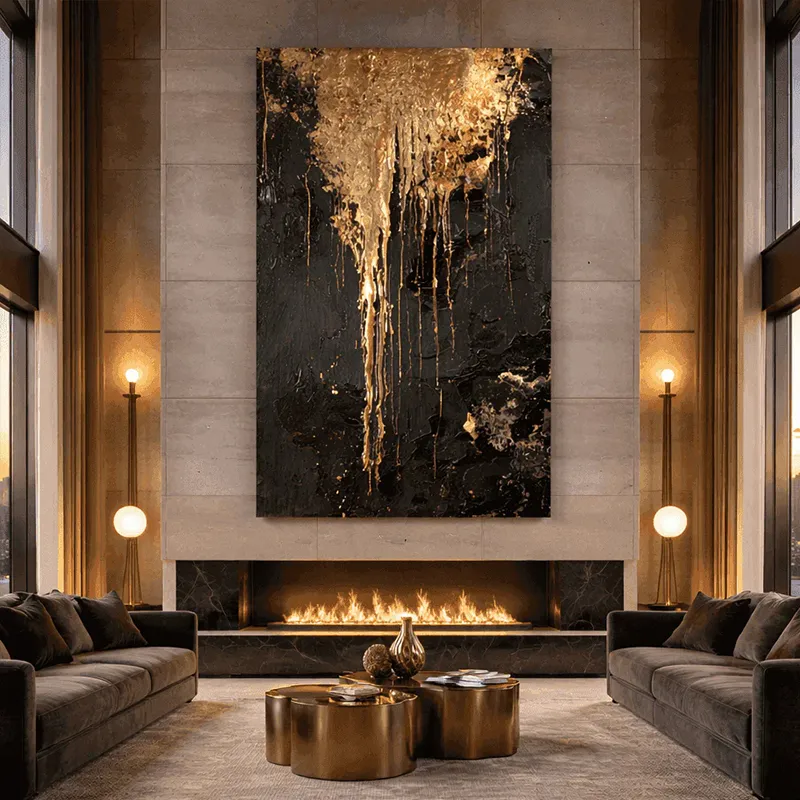
If you have recently been choosing wall decorations for hotel lobbies, clubs, showrooms, or clients’ homes, you have likely encountered something striking. An entire wall is not covered by a single painting, but rather features undulations, textures, and layers that appear when light and shadow play across it. This phenomenon is known as large-scale textured wall art.
It is neither a regular mural nor a pure sculpture; instead, it is a work of art that lies somewhere between a wall and a painting. In recent years, it has become incredibly popular on Pinterest, Instagram, and in high-end home decor circles for three key reasons.
First, after a decade of minimalism, people are simply tired of solid-color walls. Second, the wabi-sabi style and quiet luxury have made a handmade feel a true necessity. Third, it is remarkably photogenic—it looks one way during the day, but completely different at night when spotlights illuminate it and the shadows shift.
Below, we will delve into the art history and practical purchasing process, providing a comprehensive overview.

I. The Modern Mural Movement: Transforming an Entire Wall
The idea of using an entire wall as a canvas truly took hold in the West with the Mexican mural movement of the 1920s and 30s. Following the revolution, the new government needed art accessible to the general public. Consequently, they dispatched painters to depict history, labor, and local culture on the walls of public buildings.
Diego Rivera and Detroit Industry
Diego Rivera’s Detroit Industry (1932–33, Detroit Museum of Art) remains the most famous work of this movement. To understand his profound artistic background and monumental fresco techniques, you can explore the Diego Rivera Wikipedia entry. Twenty-seven frescoes surround the four walls of the atrium, with each panel on the north wall measuring 5.4m by 13.7m, totaling approximately 144 square meters. The content depicts the production line at the Ford Rouge plant—engines, transmissions, workers, and chemical workshops—and even includes a pregnant woman and bacteria viewed under a microscope.
Rivera utilized fresco, which involves painting on still-wet plaster walls so that the paint seeps into the surface and remains vibrant for centuries. He spent nearly a year in Detroit, observing factory workers daily. The significance of this work lies in bringing whole-wall narrative into mainstream art museums, rather than keeping it exclusive to churches or palaces.
Siqueiros and Orozco
David Alfaro Siqueiros, on par with Rivera, employed a much more aggressive approach. He rejected the smooth surfaces of Renaissance-style walls, using spray guns, stencils, industrial paints, and scaffolding to create distortion and oppression. Several of his murals in Los Angeles and Mexico City are now official national monuments.
Meanwhile, José Clemente Orozco painted in a dark and tragic style, favoring themes of war, suffering, and the downtrodden. His series of murals in the Dartmouth College library, depicting everything from Mayan goddesses to modern machinery, stands as one of the most important mural collections on American campuses.
Ultimately, this artistic lineage later influenced post office and campus murals throughout the WPA era in the United States, effectively using architecture to tell a collective memory.
II. Abstract Relief: Making the Painting Protrude
By the 1970s, abstract artists began to move beyond two-dimensionality, directly creating physical depth in their works.
Frank Stella and the Polish Village Series
Frank Stella was initially a representative of minimalism, painting hard-edged stripes. However, he became increasingly restless, transitioning from two-dimensional surfaces to low relief, and finally to three-dimensionality.
The Polish Village series marked a major turning point. Individual works were generally over 3 meters wide, with the thickest parts protruding nearly 50 cm from the wall. The materials included layers of wood, cardboard, felt, and thin metal sheets, referencing the wooden structures of Eastern European synagogues that were destroyed during World War II. His masterpiece, Jarmolince III, measuring approximately 295 by 229 by 20 cm, occupies almost an entire wall in an art museum.
He famously stated that what you see is what you see, meaning viewers should not look for hidden symbols because the materials, shapes, and shadows are all that exist.
Kiefer and Soulages
German artist Anselm Kiefer went even further by pasting straw, lead, ash, clay, snakeskin, and old books directly onto the canvas. His work Die Argonauten (1990), measuring 280 by 500 cm, features a surface as rough as if it were just dug from ruins. Each material speaks for itself without needing traditional paint.
Similarly, French artist Pierre Soulages became known as the black painter. He applied thick layers of black paint to the canvas, using a palette knife to create intricate textures. When light shone on his work, deep brown, deep blue, and silver-gray hues emerged from the darkness.
III. Contemporary Installation: Immersive Spaces
In the 21st century, a single wall is no longer enough for modern creators; artists now transform entire environments into immersive works of art.
Katharina Grosse and Mark Dean Veca
Katharina Grosse created CHOIR (2025, Basel), spanning 16m by 91m, using acrylic paint sprayed directly onto asphalt and fabric. The overlapping blocks of color created a massive, wrinkled visual effect. She proved that textured wall art does not necessarily require physical relief, as the layering of colors alone can be remarkably effective.
Similarly, Mark Dean Veca created Phantasmagoria, covering approximately 325 square meters across four walls. This whole-house immersive approach is now widely utilized by luxury stores and brand showrooms.
Technology and Robotic Plaster
ETH Zurich’s Robotic Plaster Wall (2022) introduced a new paradigm where an artist wearing AR glasses drew designs in an empty room. A robotic arm followed, spraying plaster onto the walls to create wave-like undulations throughout the concrete space.
Furthermore, artist Rudolf Stingel covered entire museum floors and walls with patterned carpets before painting and pressing onto them. Once removed, the carpet texture remained imprinted on the walls, blurring the line between architecture and painting.
IV. Home and Commercial Spaces: Four Popular Directions
In actual living rooms, hotels, and restaurants, four specific styles currently dominate the commercial market. If you are looking to bring these dimensional aesthetics into residential settings, you can also explore our curated selection of canvas textured wall art to find complementary focal pieces for your spaces.
-
3D Draped Plaster Wall Art: Several geometric panels cover a sofa background wall in a single off-white color, using beveled surfaces to create depth. Embodying a minimalist wabi-sabi aesthetic, it suits large living rooms and hotel lobbies.
-
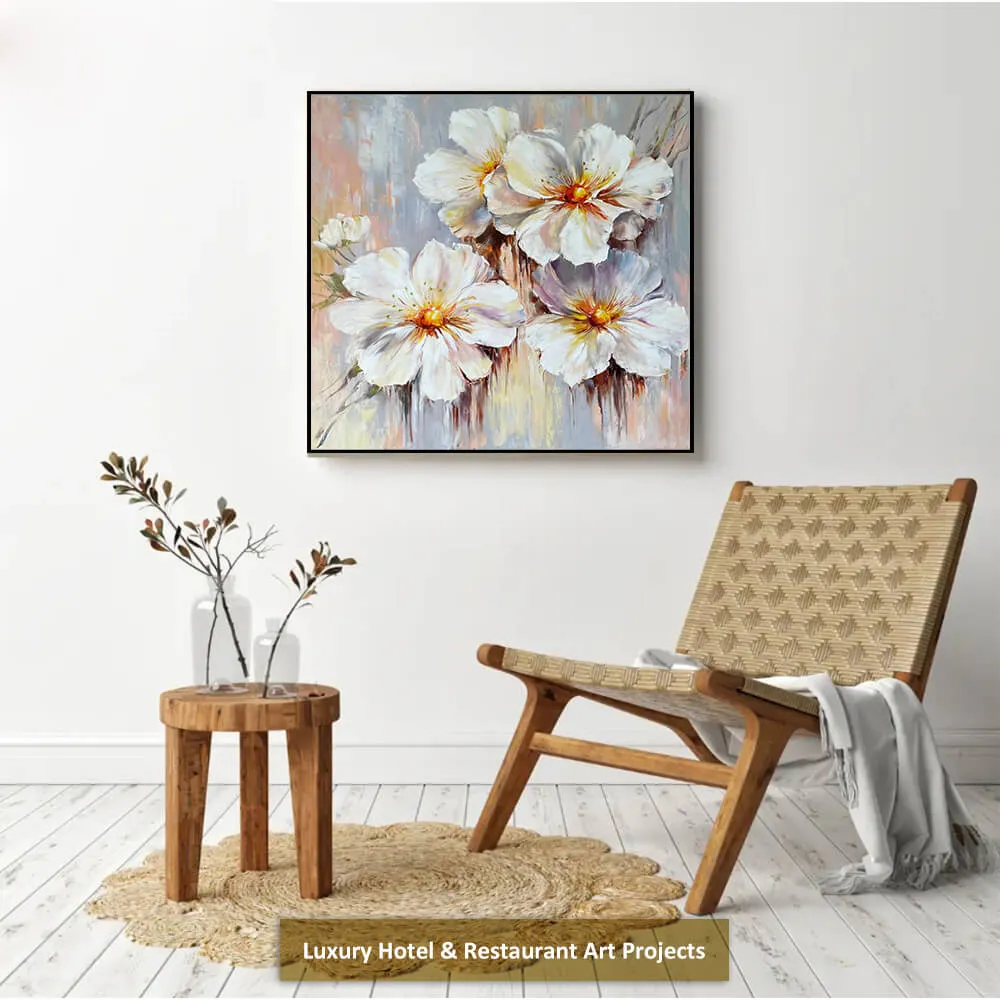
White Floral Relief Panels: Large, three-dimensional floral carvings in a matte white finish are commonly used in entryways, hotel receptions, and high-end boutiques.
-
Knife-Textured Painting: Thick layers of plaster or acrylic paint form vertical stripes or wave-like undulations in monochrome tones. This is the most versatile style for modern interiors.
-
Gold Leaf Line Drawings: Ivory white backgrounds paired with overlapping gold or black lines offer understated luxury for master bedrooms and executive lounges.
Conclusion
Creating large-scale textured wall art is essentially about crafting a wall that changes dynamically with light. From the 144㎡ fresco in Detroit in 1932 to modern plaster panels behind a living room sofa, the core logic remains unchanged: let the architectural wall itself become the artwork.