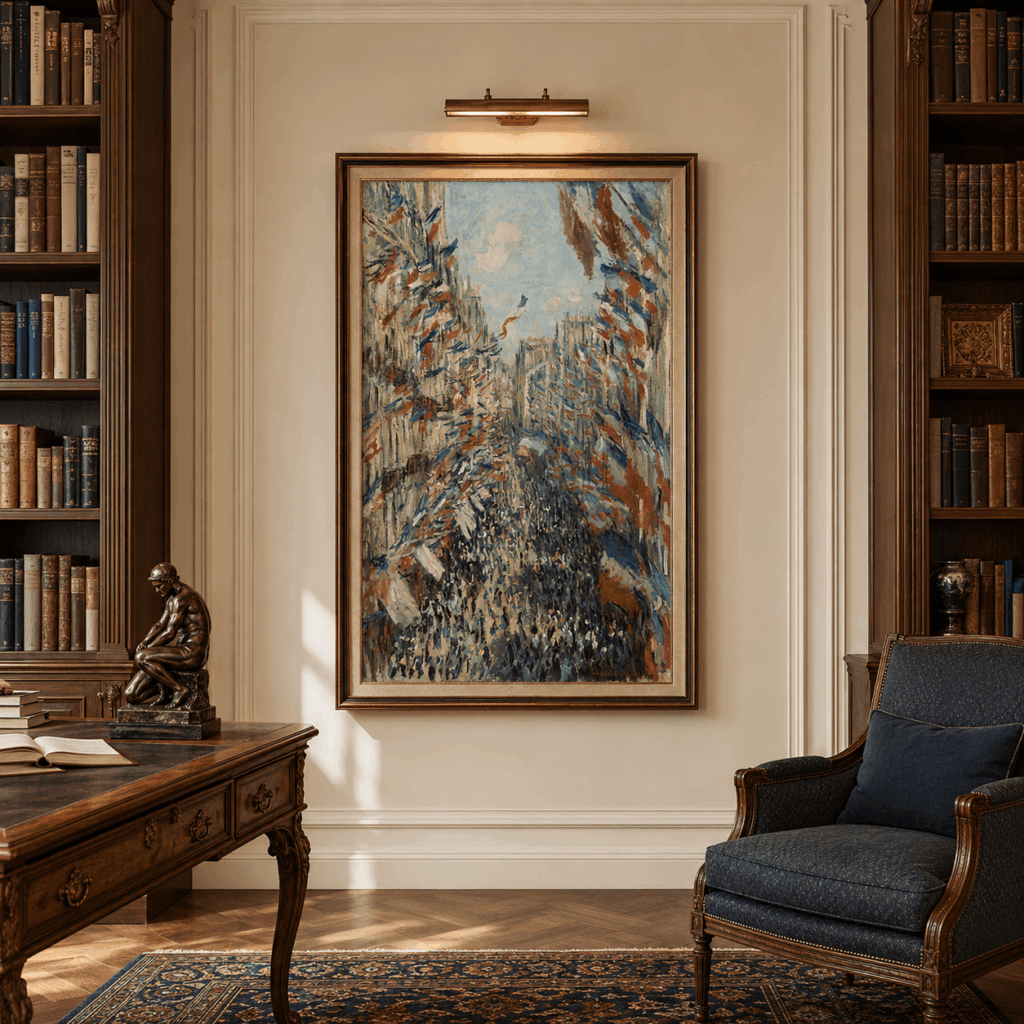
The Tricolour in Motion: An Art-Historical Reading of Monet’s The Rue Montorgueil and an Interior Styling Guide
Paris appears almost to vibrate beneath a canopy of red, white, and blue. Flags extend from balconies, sunlight dissolves architectural detail, and the crowd becomes a rhythmic current of color. In Monet Rue Montorgueil, Claude Monet transformed a public celebration into a compelling study of light, movement, and modern urban life.
Painted in 1878, the work records the festival of “Peace and Work” held on June 30 during the Paris Universal Exhibition. It was not an exhibition-closing ceremony. Instead, the event represented France’s recovery and the growing confidence of the Third Republic.
The Historical Context of Monet Rue Montorgueil
France was still rebuilding its national identity after the Franco-Prussian War. The 1878 Universal Exhibition presented the country as culturally resilient and technologically progressive. Meanwhile, the June 30 celebration gave that recovery a visible public form.
According to the Musée d’Orsay, Monet observed the festival from an elevated window rather than from within the crowd. This high viewpoint allowed him to organize the street as a deep vertical corridor.
The original oil painting measures 81 × 50 cm. Its narrow format reinforces the sensation of buildings, flags, and people flowing into the distance. Therefore, the composition functions as both an urban landscape and a visual document of modern French society.
Impressionist Brushwork and Optical Color
Monet avoided precise architectural description. Instead, he used flickering, broken brushstrokes to suggest movement. Flags are reduced to energetic marks, while individual figures merge into a dense field of light and shadow.
Red, white, and blue recur across the canvas. However, Monet rarely isolates these colors within rigid outlines. He places contrasting tones beside one another, allowing them to blend optically at a normal viewing distance. This technique creates greater luminosity than conventional color mixing.
Moreover, the pale blue sky provides visual breathing space. It balances the crowded lower section and prevents the strong national colors from overwhelming the composition.
Interior Applications for Monet Rue Montorgueil
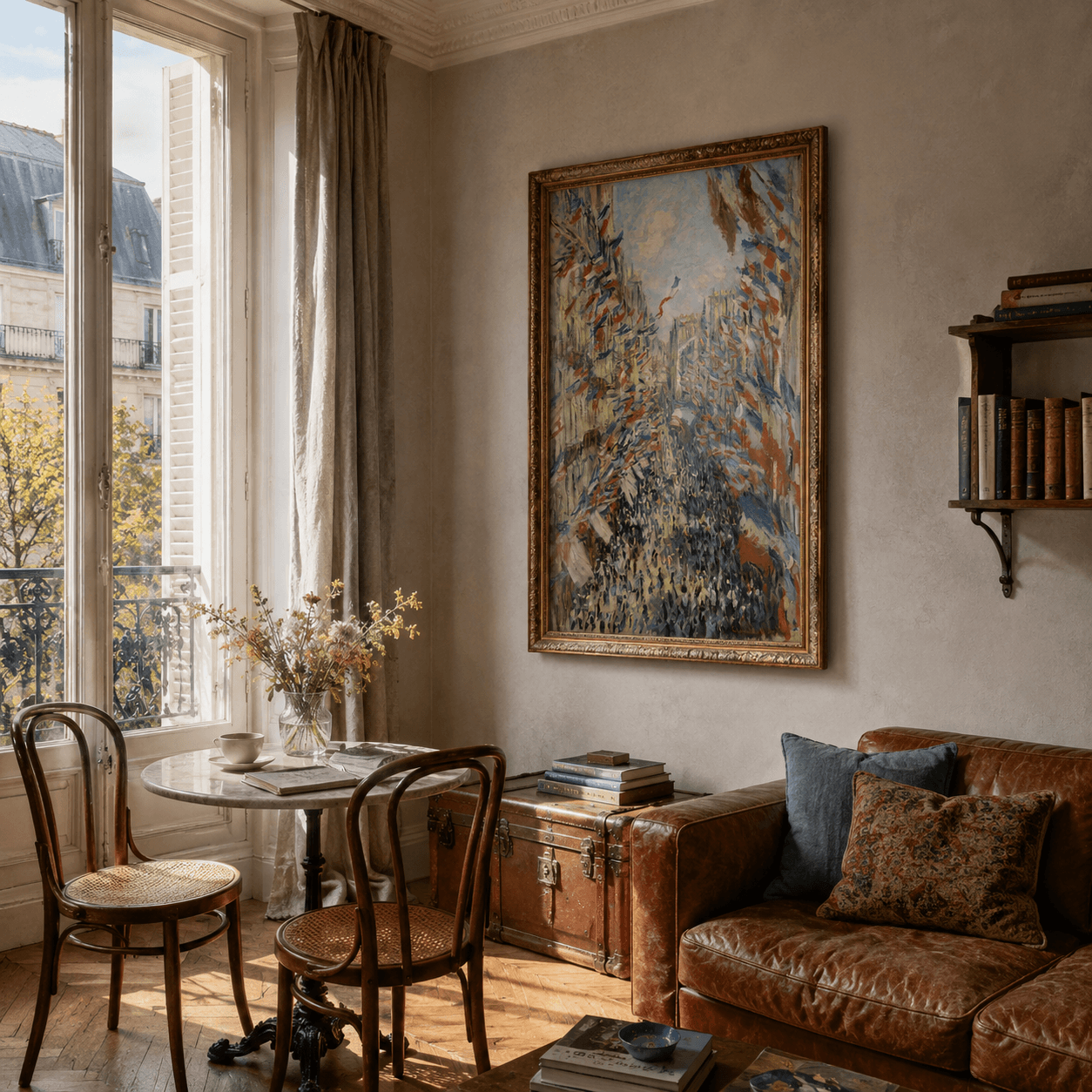
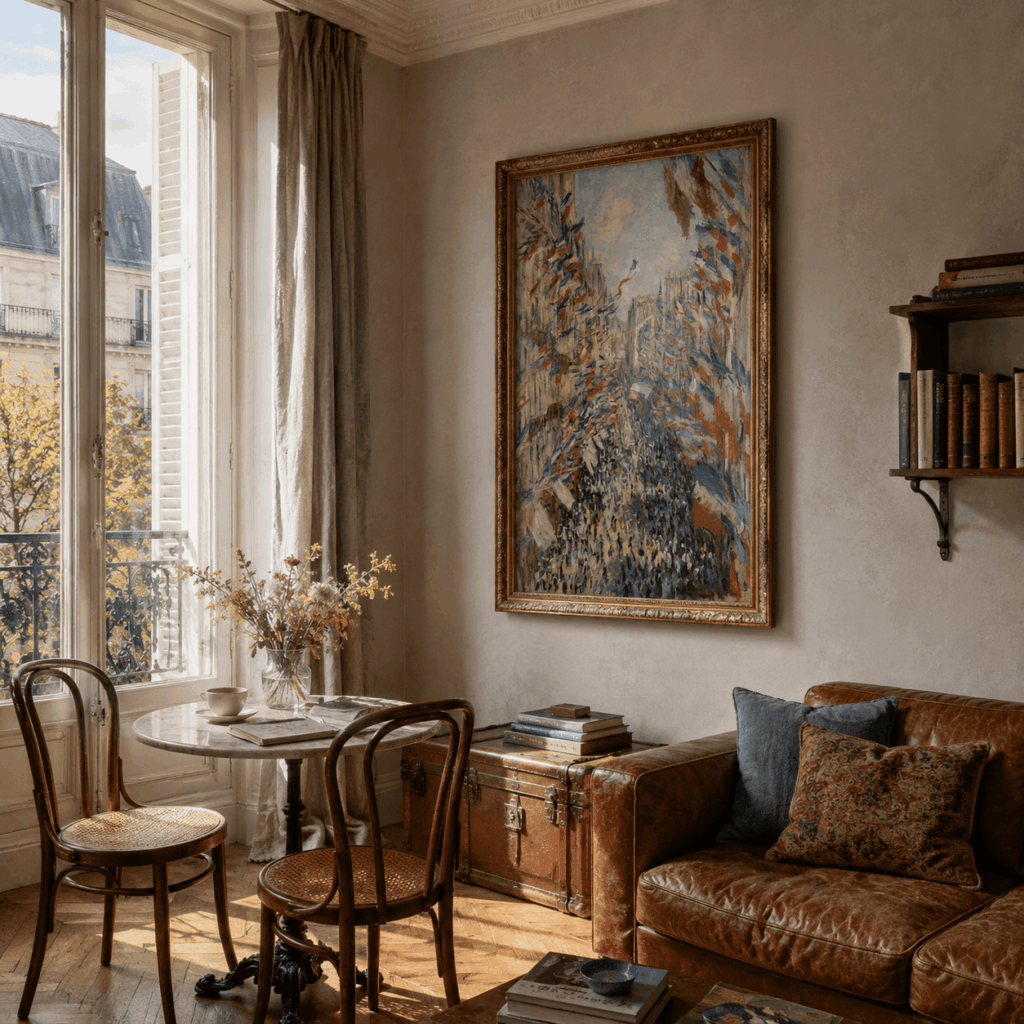
The painting works particularly well in French vintage, contemporary luxury, and carefully curated eclectic interiors. Its historical subject adds cultural depth, while its energetic palette prevents a room from feeling overly formal.
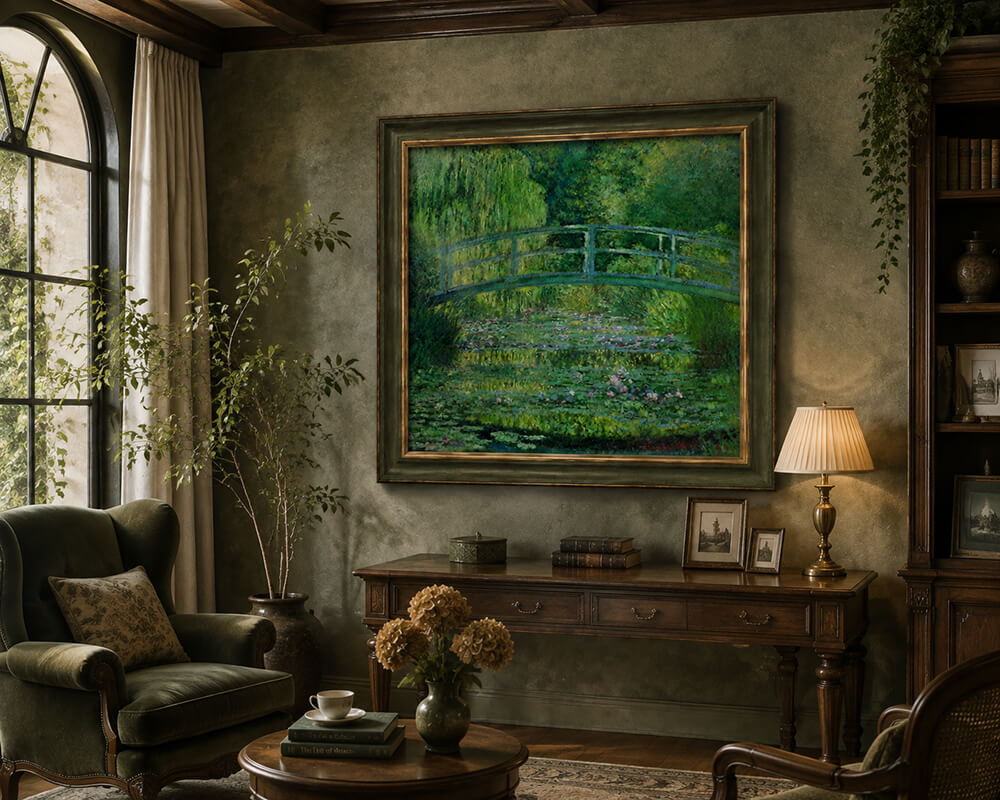
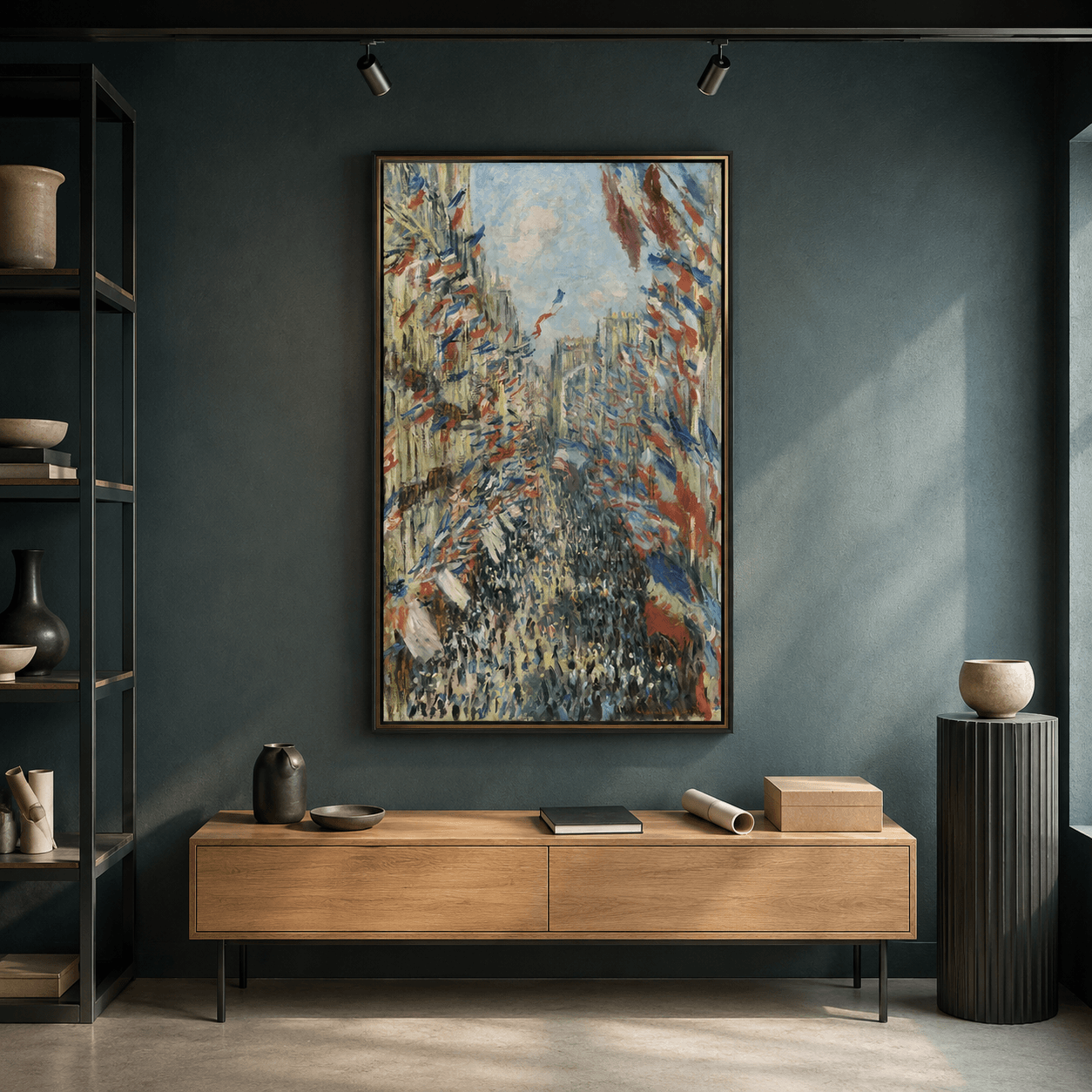
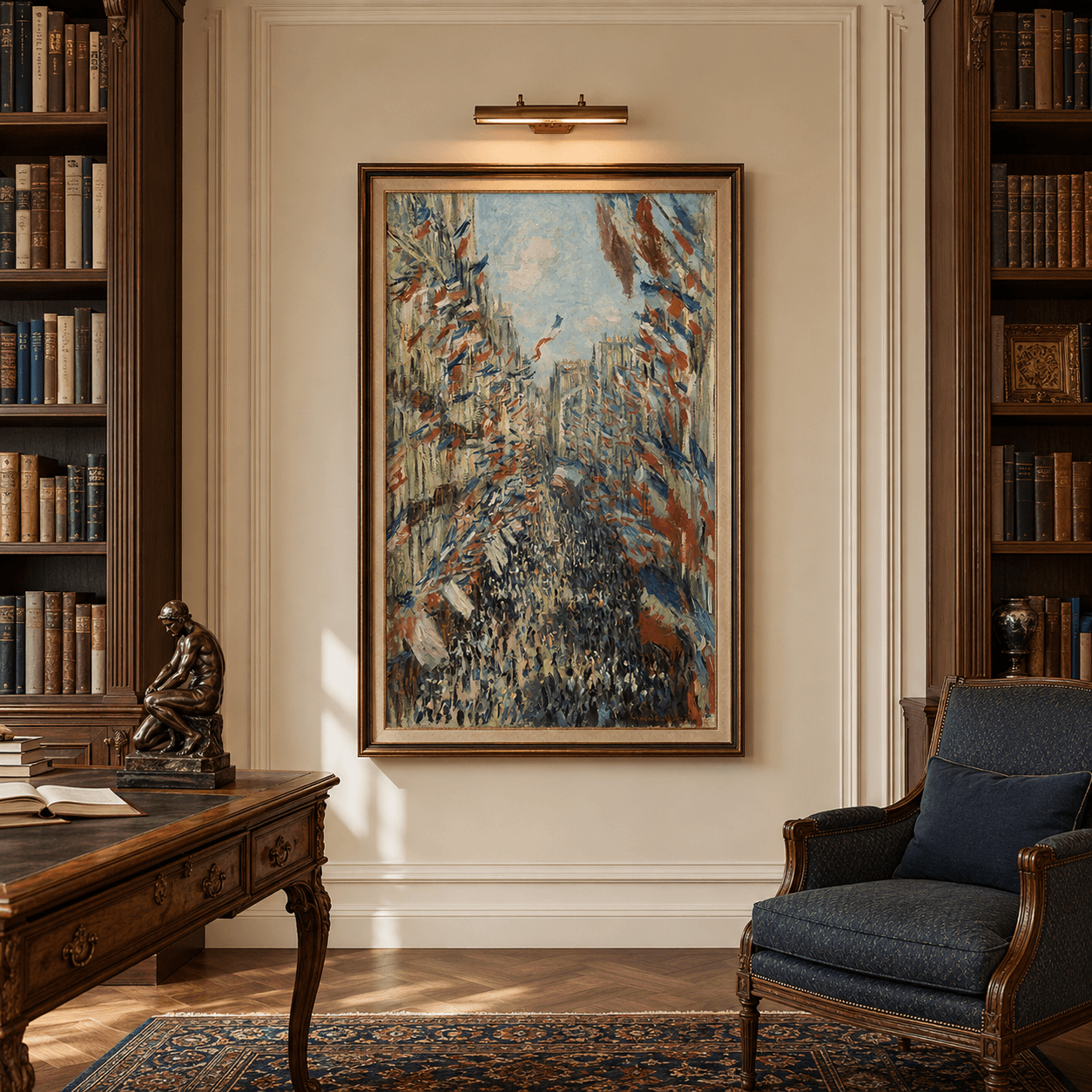
In a library, study, or boutique hotel lounge, the reproduction can function as sophisticated vintage wall art. A dark walnut, antique-gold, or black-and-gold frame strengthens its museum-inspired character.
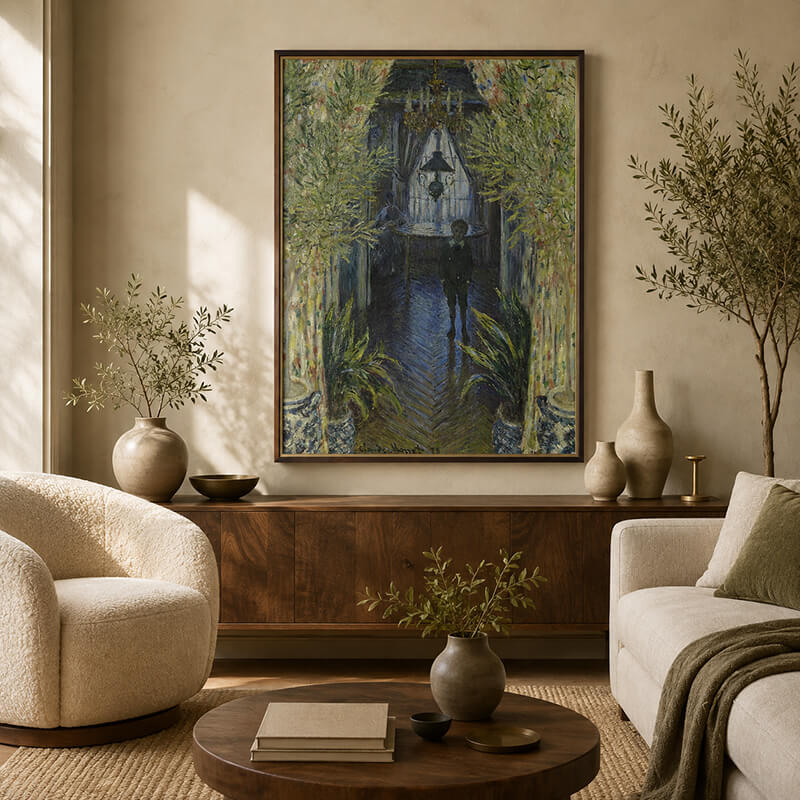
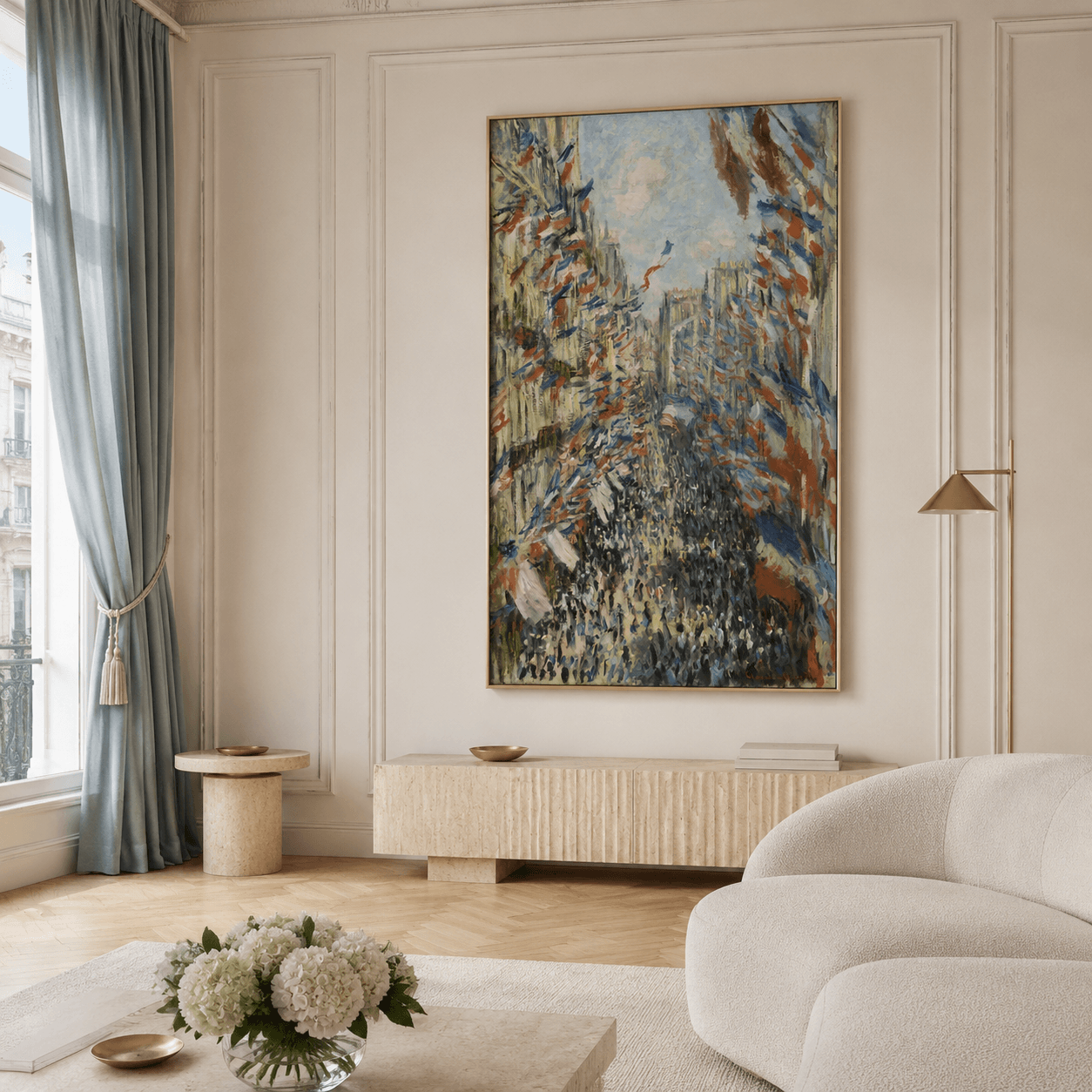
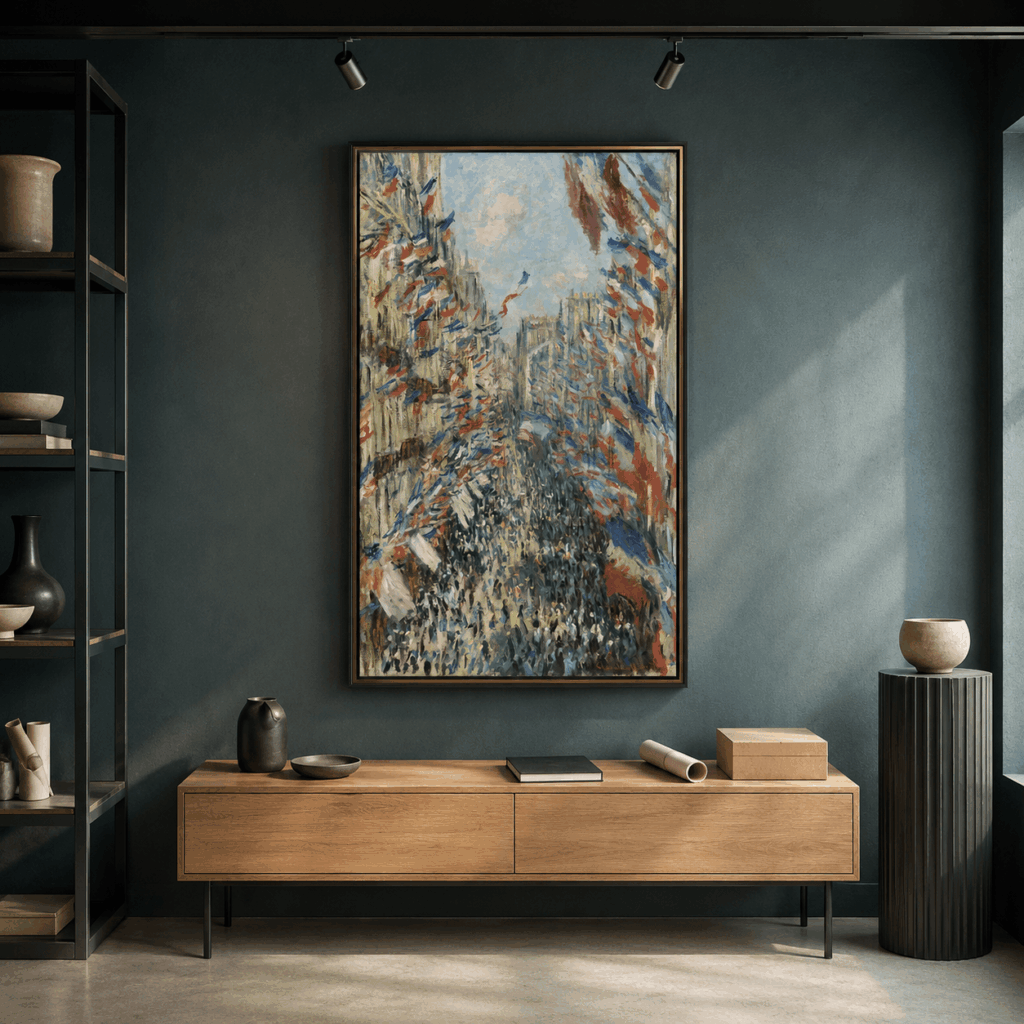
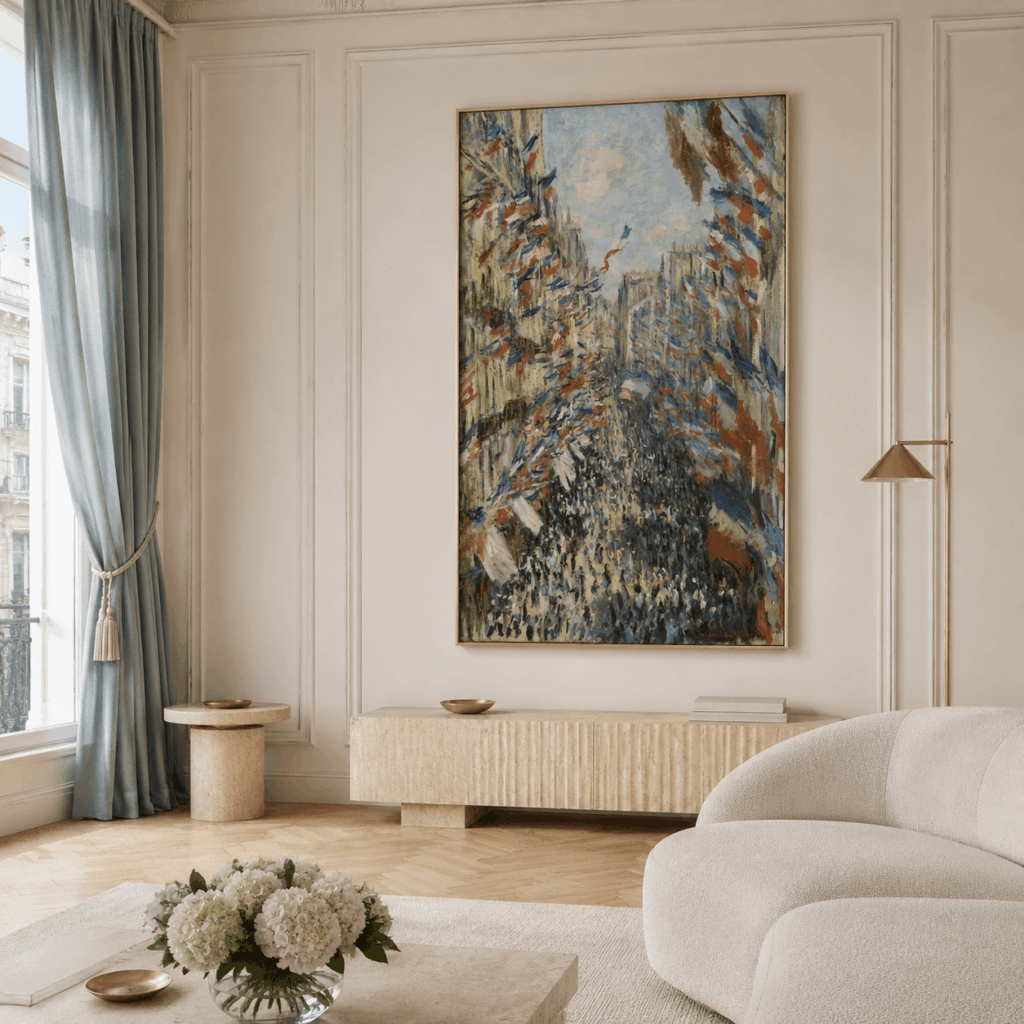
For a contemporary living room, a slim champagne-gold or matte-black frame creates a cleaner presentation. A spacious feature wall may also support an extra large wall art for living room arrangement. The enlarged format gives the flags and crowd greater visual impact, making the artwork an effective focal point.
Meanwhile, medium formats are more suitable for corridors, reading areas, and compact offices. In every case, the frame width and artwork size should respond to the wall dimensions, furniture scale, and normal viewing distance.
Selecting a High-Quality Monet Reproduction
Archival giclée canvas offers a textured surface and is well suited to large-format, glass-free display. Fine art paper can reproduce small details more sharply, although it normally requires glazing and protective framing.
If a product listing only describes the material as paint canvas, buyers should request further specifications. Important details include canvas weight, ink or pigment type, color-management process, protective coating, frame construction, and expected resistance to fading.
Color accuracy should also be assessed carefully. The blue-gray sky must retain subtle tonal variation, while the red flags should remain vivid without appearing excessively saturated. Most importantly, the darker crowd area should preserve depth rather than becoming a flat black mass.
Conclusion
Monet’s The Rue Montorgueil combines historical meaning with remarkable decorative energy. It can introduce movement, cultural character, and sophisticated color into both residential and commercial spaces. Explore selected Impressionist wall art and French-inspired home décor to bring this celebrated vision of Paris into a contemporary interior.